

- After powerful testimony about the devaluation of our labor, UC-AFT members held an energetic rally with members of UAW 4811, AFSCME, UCSC Faculty Asso, and student allies.
- We passed our proposal on Article 35, which would enshrine our right to free expression in our no strikes / no lockouts clause;
- UCOP proposed modest changes to Articles on Resignations (18) and Medical Separation (16).
Our UC-AFT Table Team kicked off its bargaining session at UCSC on June 4 by following up with UCOP about layoffs of language lecturers and UC’s threatened shift to online instruction through the Global Languages Network (GLN). When asked for a justification of the GLN, UCOP reps claimed that its purpose is to preserve language instruction which would otherwise be canceled due to low-enrollment, moving classes online where they might attract more students across UC campuses, and to incorporate AI as “a tool, not the sole instructor.”
Table Team member Alison Lipman refuted UCOP’s claim, arguing instead that many canceled language classes from across UC have been fully enrolled, popular courses and invited UC-AFT members to testify to that fact. Tonia Prencipe, lecturer in Italian who has taught at UCSC for 30 years, spoke about Italian 101, a class she teaches that routinely fills to its 50 student capacity. She’s received no answer as to why it has been cut but clearly “low enrollment” is not the cause. Stephanie Lain, continuing lecturer in Spanish at UCSC, pointed to a recent policy that arbitrarily prevents lecturers from teaching upper-division courses, including her upper-division course, “Society and Sustainability in Latin America,” which she was the first to develop and teach. “By attempting to deprofessionalize our work,” Lain said, “the administration moves one step closer to eliminating our lecturer job title.” I Ju Tu, lecturer in Chinese, added that her recent reappointment reduced her previous 8 courses to just 2, resulting in a 75% cut to her income and the loss of her health insurance. Her other courses didn’t disappear, they were reassigned to another, less experienced lecturer and a senate faculty member, suggesting her 75% reduction in time was a restructuring project dressed up as a staffing choice.
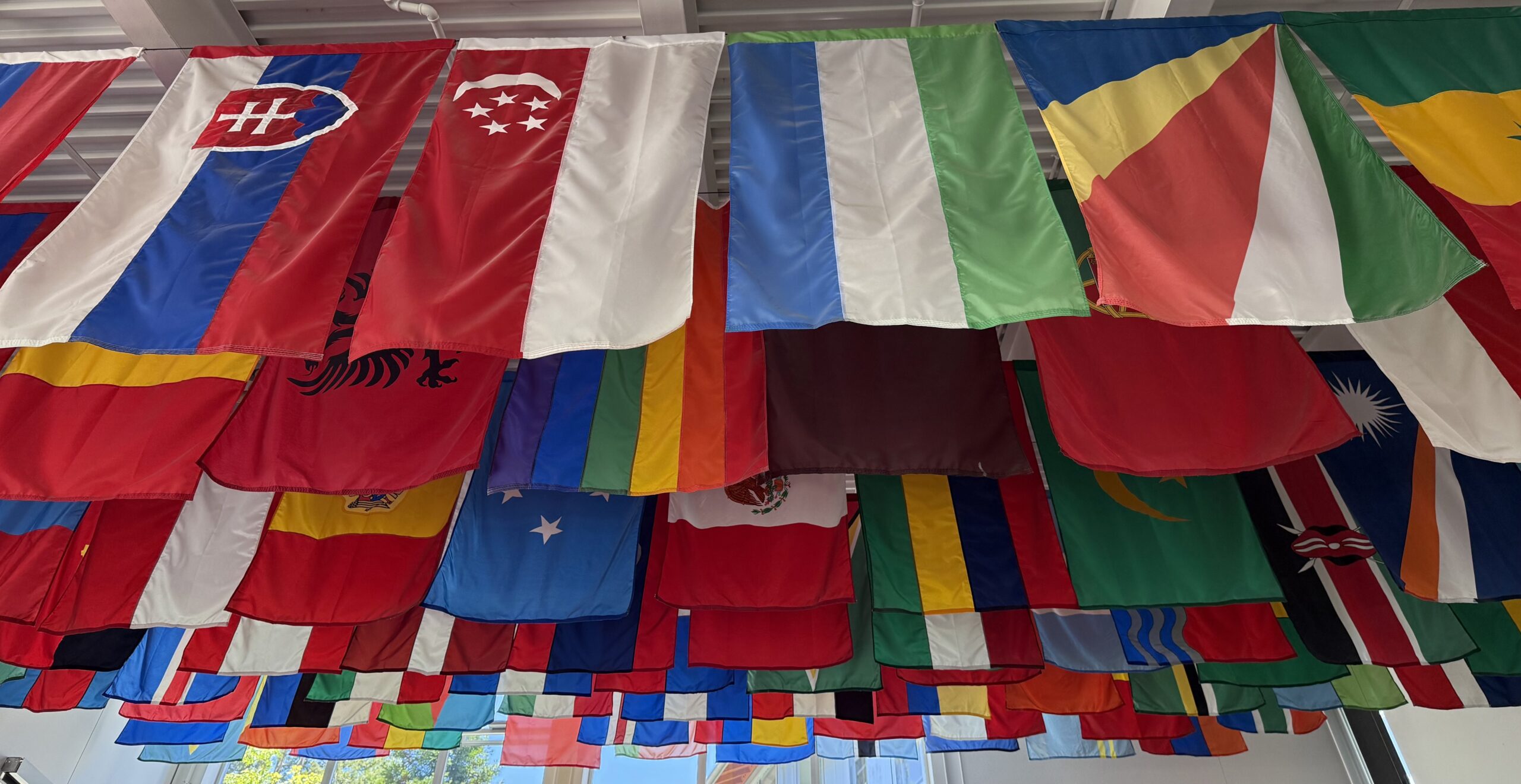
The morning’s testimony highlighted the importance and popularity of language lecturers at UCSC, where the administration has eliminated German, Italian, Arabic, and Farsi, while instituting severe cuts in Spanish and French. The lecturers who taught in these programs had developed original, well-enrolled language classes that went above and beyond. Prencipe, for example, created a meaningful study-abroad program for UCSC students on the Amalfi coast to offer cross-cultural immersion. Lain taught students Spanish by teaching them about sustainability in Latin America, an understandably popular topic at UCSC, and Tu’s courses familiarized American students with the cultures of China, while providing international students a place to be in-community far from home. All were well-enrolled and contributed not only to the mission of the UC, but also to the International and Global perspectives fundamental to UCSC’s College Nine, where bargaining was held. As senate faculty member Maria Davis stated in her testimony about the importance of language lecturers, “We are in a room with a lot of flags … living in a moment of xenophobia and racism.” The courses that lecturers design and teach are a bulwark against this contemporary closure of the American mind, a ray of light in dark times, a source of multilingualism amidst a turn away from the world community.

A second set of testimonials continued the emphasis on UCOPs devaluation of the labor and dignity of teaching faculty. Jared Gampel spoke to his 20-year experience at UCSC – first as an undergraduate, then graduate student, and now lecturer – about the ways that the UC overworks lecturers and graduate students alike. Gampel’s transition from a graduate student to a lecturer has meant he isn’t able to do the research and writing he was trained to do and resulted in a pay cut per class taught. The UC system and UCSC, Gampel noted, has “devalued labor and, as a result, my life.”
Lecturer Amanda Reiterman began her testimony short of breath after running from class to get to the bargaining table. Noting that she had recently been laid off from teaching Latin she spoke to the importance of that class, pointing to a computer science undergraduate who told her his reason for taking Latin was, “to make friends…. he was lonely.” This anecdote points to the difficult to quantify value of languages and the humanities where students look for smaller courses with more human connection. When lecturers like Reiterman who teach courses like Latin are laid off, this student reminds us, we don’t only lose amazing lecturers; we lose the kind of courses that actually build community on campus, lead to student retention, and sustain us as individuals and campuses alike. In light of persistent cuts to languages and humanities, Reiterman likened the vibe on campus to “the last days of the Roman Empire.”
Christie Mccullen, continuing lecturer in sociology who designed and teaches a course on the Sociology of Postpartum spoke to the sorry state of UCOP’s parental leave and childcare policies when it comes to teaching faculty, noting that we receive far less support than do our graduate student instructor and senate faculty colleagues.
Taken together these testimonials point our way forward. Against austerity measures aimed at sinking the humanities, against the layoff of lecturers and against AI driven “education” that alienates students and undermines retention. In turn: for rich, rewarding education where “the learning process can be slow and immersive … the antidote to shallow knowledge,” as Reiterman described. She ended her testimony with a plea to UCOP that informs what we’re fighting for in our contract campaign: “Find your soul again UC. Your students deserve that.”
No Strikes clause – “Decent humans don’t cross picket lines”
Our table team also used the day’s bargaining session to present our proposal for new language concerning Article 35, known as the “No Strikes / No Lockouts” article. Josh Brahinsky, lecturer in UCSC’s John R. Lewis College, introduced the topic with our last testimony for the day. He spoke powerfully about the injury to conscience that arises for so many of us each time one of our sibling unions goes on strike and we are compelled to engage in business as usual. In these cases, Brahinsky noted, “I’m being asked to teach when it’s an absolutely unethical thing to do,” proclaiming that, “an injury to one is an injury to all.” If our constitutional and human rights are to remain meaningful, and if we are to maintain good relations with our students who are looking for ethical and principled teachers, then we ought to have a contract that recognizes and enshrines our ability to follow our consciences, Brahinsky said, adding that decent humans that “don’t cross picket lines.”
At this point table team member Joseph Klett presented our proposal on Article 35. The changes the Table Team proposed would address the shortcomings of the current contract by making explicit the fact that teaching faculty retain our rights to free expression and can act on their own conscience without fearing disciplinary measures from the administration. It specifies that in the event that our sibling unions go on strike, Unit 18 Teaching Faculty will not be asked or expected to: complete struck work previously assigned to GSIs and Readers; take on additional tasks; alter curriculum or compromise academic integrity. It would also give lecturers the option to have student evaluations for courses affected by strikes excluded during academic reviews. Our proposal is designed to bolster our rights to free expression and better protect us from increases in our workloads, forced curricular changes, or pressure to lower academic standards when our union siblings flex their labor power.
Lunchtime Rally – “We, the workers, are the stakeholders”
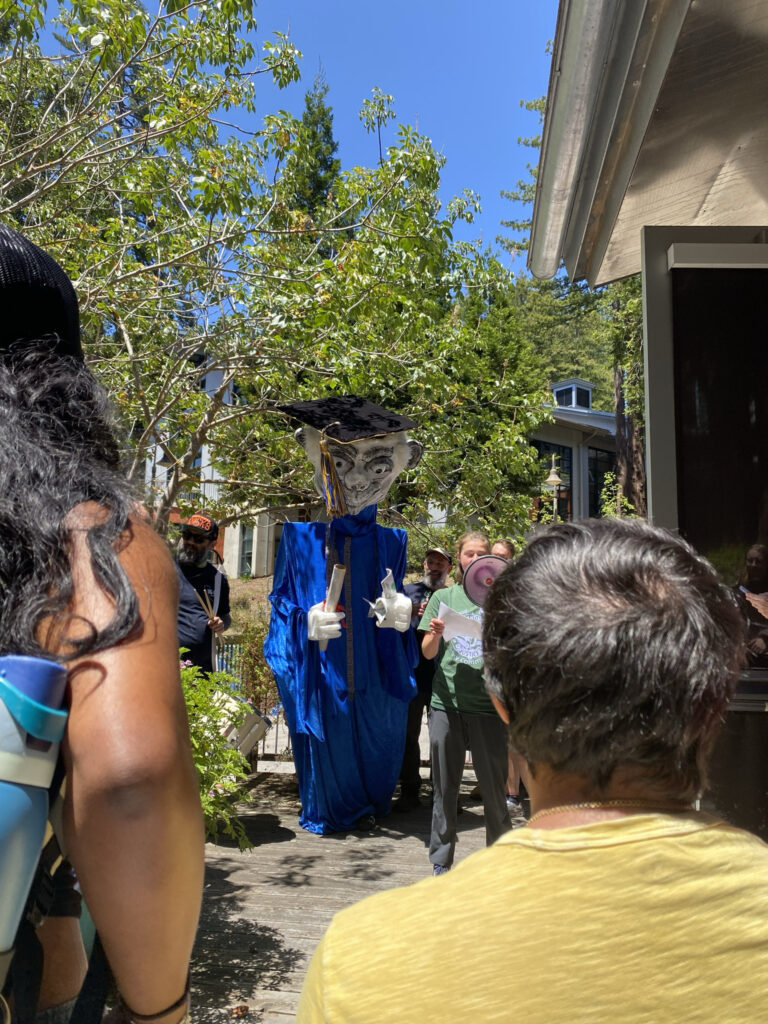
Riding high on this energy, the Table Team wrapped the first half of the day for lunch and went outside for a well-attended and energetic rally organized by UCSC lecturers and allies. Many of the featured speakers were students who spoke in support of their teachers and in defense of language education at UCSC. Students spoke passionately about how learning languages exposed them to new cultures and opened new opportunities, one arguing forcefully that language classes on zoom could never replace the experience in the classroom. “We want to learn,” she said, “…if I want to go study abroad, be in another country where I don’t speak the language, if I want to be prepared for that life-changing experience that will help me grow… I need to be in class, with the professor, with my peers, building that beautiful community.”
Labor allies also spoke at the rally in support of UC-AFT teaching faculty. AFSCME 3299 member Christopher Contreras Sr. spoke about his union’s recent contract victory and the need for cross campus solidarity. “Each and every one of us is important,” Contreras said, “we are the heart of UC.” His sentiment was echoed by members of Phredd Groves from UPTE and Jessica Taft of the UCSC Faculty Association, who pledged to fight alongside their teaching faculty colleagues. Rebecca Gross, a member of UAW 4811’s bargaining team, spoke of the shenanigans that they had dealt with to win their recent contract fight and what a difference changes in the No Strikes clauses of our contracts could make in the future. She also underscored the absurdity of the UCSC’s administration’s decision to close vital language programs in her own department: “The university would rather spend $25 million to renovate the Bay Tree bookstore… than actually funding the education of students that are paying tens of thousands of dollars a year. What do we think about that?” Her question was met with boos and shouts of “shame” from the crowd.
What UCOP Passed to UC-AFT
After the lunchtime break, the representatives of UCOP opened the discussion before presenting their proposals for the day. They started by expressing their concerns about our Article 35 proposal and argued that the purpose of collective bargaining was to ensure “labor peace.” Other representatives questioned whether Unit 18 Teaching Faculty could be considered “supervisors” under the definitions in HEERA. UC-AFT co-chief negotiator Kat Lewin quickly dismissed their concerns by reminding them that, “One way UC can ensure labor peace is by ensuring that [workers] don’t have to go on strike.” Their suggestion, that exercising our legally-protected rights would be “non-workable” from UC’s perspective, flies in the face of the principles of collective bargaining enshrined in existing labor law.
UCOP then proceeded to offer some “testimonials” of their own to support their proposals for the day on Article 18 (Resignation). A representative from UCSD told of her trials and tribulations when a Unit 18 Teaching Faculty stopped responding to university communications and engaging in their assigned duties. Unable to reach the lecturer, the university was forced to “make contingency plans for continuity of instruction.” Another UCOP representative told of trying to offer a Unit 18 lecturer a job and never hearing back about the offer. Such incidents have convinced the UCOP that they “need a mechanism” to address similar situations – what they are calling a “presumptive resignation” that would occur when the university does not hear back within 7 days. UCOP similarly presented their proposal on Article 16 – Medical Separation, which makes what they describe as “procedural changes,” while offering no specific examples of issues that have arisen from our current contract language.
Beyond their “testimonials,” UCOP did not produce any relevant data to support their claims about the urgent need for a “presumptive resignation” clause or revisions to our Medical Separation article. Our Table Team will review their proposed changes closely and carefully to ensure they cannot be abused to undermine our rights. But one thing remains clear: while teaching faculty continue to raise serious issues at our bargaining sessions, sharing heartbreaking stories about cancelled classes and mass layoffs, the university continues to respond with narrow, technical proposals that would only apply to a few people in rare cases. Thus far, they have been unwilling to offer any proposals that address the existential threats that we face.
Future Bargaining Sessions
At the very end of the day, we returned to the conversation about bargaining ground rules and the schedule for upcoming negotiations. UCOP representatives once again “testified” to the hardships they were forced to endure when we bargained on zoom because of the “chat and emojis” that had gone on. They repeatedly noted how “distracting” the emojis were, claiming their representatives had to “minimize the screen,” “close the chat,” or close their laptop entirely due to “sensory overload,” and charged that some in attendance were “doing a lot more than observing.” As one UCOP rep described, the bursts of emojis in support of our table team made him “feel like I was having confetti thrown in my face.” For these reasons, UCOP’s proposed ground rules that would turn off the chat feature entirely and limit zoom room access to 40 people, a significant decrease from their original proposal for a 475 person cap. Limiting the number of observers, they argued, would mirror in-person bargaining and avoid the “interruptions and disruptions” they experienced on zoom.
Our Table Team members repeatedly stressed that zoom bargaining is a vital way to expand our members’ participation in the bargaining process. “We are a democratic union,” said Joe Klett from UCB, “We have a responsibility to our members. They want to hear from you. They want to hear you directly.” They questioned why UCOP was insisting on having a list of observers attending on Zoom and what they planned to do with that list, especially given the UC has been found to have shared data with the federal government in recent weeks, to which the UCOP said they have no plans to “misuse” the data. But while the chat and emoji settings can be easily changed, the limits on observers on Zoom that UC is proposing would fundamentally restrict our members’ access. As Kat Lewin noted, Zoom makes bargaining accessible to people “whose lives will be changed by our contract [but] who are engaged with very important things that keep them from being here; childcare, elder care, members with disabilities… [this] is about the hundreds of people who could be in the room if not for the precarity of their lives.”
UC-AFT proposed additional dates for in-person bargaining sessions during the summer, including on June 30 (location TBD), but UCOP has only confirmed the details for one: a two-day session at UCSB on July 15 and 16. More information to come soon – for now mark your calendars and be there!
Leave a Reply