UC’s Problem: Existing career pathways for skilled and experienced educators are unstable
UC teaching faculty believe that every UC student deserves access to high quality instruction, delivered by professional educators who value critical thinking, information literacy, and free inquiry. Our collective bargaining agreement outlines procedures for academic reviews and awards merit pay increases to those who pass them. But in practice, these processes can feel opaque and capricious. Promotion structures vary from campus to campus and within divisions and departments, making it difficult for teaching faculty to grieve arbitrary and unjust review outcomes. Our current contract language creates uncertainties that make all Unit 18 faculty, even those in advanced stages of their careers, feel precarious.
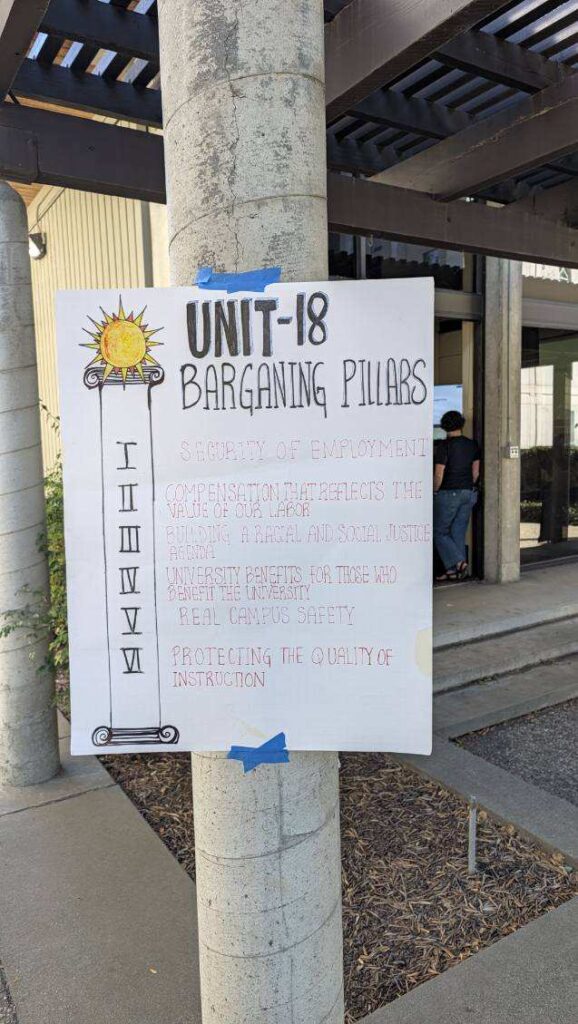
UC-AFT members voted nearly unanimously that establishing security of employment must be a central pillar of our new contract campaign. There are several articles in our contract related to job security, including articles 7a, 7b, 7c, and 7d, which outline the nature of our appointments. Our Table Team has offered exciting proposals on the 7s that would restructure our positions as open-ended appointments with permanent budget lines and eliminate the painful reappointment process.
Our table team has also put forward proposals on Articles 22 and 31. Our hope is to strengthen our career pathways by reorganizing and refining merit review processes, making them more consistent across campuses, and ensuring our fellow Unit 18 faculty have a role in the process.
We are proposing to reorganize the structure of our current contract Article 22 to make it easier to enforce the protections therein. We are also proposing changes that will align review processes with our transformative proposals on the 7s and increase our compensation. This includes new language that:
Regularizes merit reviews for all Unit 18 academic employees to every three years;
Standardizes promotion structures and review periods across campuses;
Guarantees full voting rights for Unit 18 faculty members serving on review committees;
Provides a“terminal year” to Lecturers who do not pass the excellence review and need to go on the job market;
Raises salary point increases for positive merit and promotion reviews:
Ensures there are no ceilings on salary point increases for merit and promotion reviews and that salary increases go into effect on time to reduce late notice and “retroactive” payments.
Prohibits the use of AI in merit and promotion reviews.
Prohibits artificial caps on the number of Unit 18 faculty who are promoted or receive accelerated merits.
Our proposal on Article 31 clarifies the standards of academic excellence to promote consistency and fairness in reviews and enhances our ability to grieve arbitrary and capricious review outcomes. This includes:
Adding language prohibiting arbitrary, capricious, and discriminatory decisions with merits and promotions;
Adding more clear and explicit definitions for the standards for each review (pre-continuing merit, excellence review, senior continuing promotion review, and continuing and senior continuing merit);
Expanding the criteria for teaching faculty whose assignments are not limited to instruction;
Outlining which review materials are required and optional;
Tightening rules around the use of student comments and evaluations in reviews;
Clarifying that teaching faculty’s creative work, professional and university service may be taken into account in merit reviews;
Expanding parameters for grieving unjust decisions.
Even before the Trump administration issued its sweeping and unlawful orders barring DEI, our teaching faculty colleagues from marginalized backgrounds faced tremendous challenges on campus that undermined their rights at work. Now, as we confront unrelenting attacks on campus and beyond, we have seen campus administrators buckle under pressure, conceding to bad faith charges and unlawful executive orders that further jeopardize teaching and learning at our University. UC administrators claim they will defend us and our students but too often, they offer the bare minimum protections required by law. In this contract fight, UC-AFT members have committed themselves to advancing a racial and social justice agenda in the hopes we can create a more equitable and inclusive UC for all.
In consultation with the Anti-Racism Committee, your UC-AFT Table Team has put forward the following proposals:
Proposed changes will make Article 4 stronger and enforceable by:
Adding language that outlines the University’s commitment to fostering a workplace free from discrimination, subordination, harassment, retaliation, and abusive conduct;
Expanding and contextualizing definitions of protected identities to be more explicit about race, religion, immigration status, gender identity and expression, and physical and mental disability;
Adding language that protects Unit 18 faculty from association-based discrimination and retaliation;
Adding language that addresses barriers to employment and promotion for historically marginalized people and ensures equitable access to employment opportunities;
Adding language that protects Unit 18 faculty from retaliation for reporting (of discrimination, harassment, sexual harassment, abusive conduct), filing a grievance, requesting accommodations, engaging in any union activity, or exercising their rights;
Requiring the university to provide and inform U18 faculty of accessible campus resources, including lactation spaces and all-gender restrooms;
Refining procedures to strengthen grievability and arbitrability and ensure timely formal investigations, and delineate an arbitrator’s remedial authority.
A vestige of the employer sanctions codified in the 1986 Immigration Reform and Control Act, this article outlines protections and procedures for Unit 18 faculty on non-immigrant visas. In our current contract, the article is short, with limited specificity, leaving teaching faculty vulnerable. UC offers little support in the visa application process and to those facing issues, and sometimes fails to rehire them when they lose work authorization.
At a moment when our immigrant neighbors are under attack, we want to expand Article 34 to include new language that:
Clarifies that International Students & Scholars Offices (ISSOs) are responsible for managing visa paperwork for Unit 18 faculty, as they do for senate faculty;
Strengthens protections for Unit 18 faculty who lose work authorization;
Expands assistance to Unit 18 faculty facing immigration issues, including regular workshops, paperwork assistance, and legal resources;
Promotes UC’s sponsorship of more appropriate visas and permanent residency for Unit 18 faculty, as they do for senate faculty;
Clarifies protections for personal information;
Strengthens protections against immigration enforcement on campus.
The pursuit of knowledge requires that we ask difficult questions. We believe that our professional judgement, and not university administrators, should serve as a guide to what we teach in the classroom. When academic freedom is attacked, we all suffer, and our colleagues from historically marginalized backgrounds are often the most vulnerable. Another of our major Bargaining Priorities for this campaign is to address the attacks on academic freedom on campus by protecting faculty’s ability to teach, research, and speak openly without institutional interference, as outlined in Article 2. Read more about our Article 2 proposal here.
UCR members and allies testified about the devastating impacts of sudden reductions in time and the shocking loss of longheld employment;
Our Table Team passed proposals to reframe academic responsibility, increase professional development funding, and create parity in pay, workload, and support for Summer Session teaching;
UC passed minor technical updates to articles while once again failing to address our major concerns.
The Fight Before the Fight: A Win for Member Power
The road to the best contract in higher ed is paved with a million small victories, many before we even reach the bargaining table. At UC Riverside, UC claimed the only bargaining rooms they could find were a 20-minute walk from main campus – in 100-degree heat! The Table Team pushed back … but UC wouldn’t budge.
But our UC-AFT members got the goods! UCR chapter leaders proved how inaccessible the rooms were, identified better venues, and their advocacy worked! We won central-campus rooms that were packed with Unit 18 faculty, allies and undergraduates throughout the day. It was an important reminder that members can move UC where the Table Team alone can’t.
Unfortunately, there has been no progress in negotiating zoom bargaining. We hope this will be addressed soon, as zoom not only makes bargaining more accessible to all, but also because it was vital to our last contract negotiation, enabling members across the state to attend and participate in unprecedented numbers. We cannot win this fight without all of us.
UCR testimony: Precarity, Layoffs, and the Student Experience at UC
As bargaining began, lecturers and students shared powerful testimony about the human cost of job insecurity. Their stories made it clear that behind every layoff and reduced appointment are real people, real families, and real consequences for our students.
Matthew Rotondi’s life has been upended by the UC. A Continuing Lecturer in Sociology, he received a dramatic reduction in appointment before the start of this year, and notice that he would be fully laid off in the spring. In emotional testimony, he shared: “I stand here emotionally and financially broken, exhausted, sad, fearful, and angry. Yet, I will teach my one class this afternoon with poise and professionalism.”
Two longtime Creative Writing Lecturers gave impactful testimony about how job insecurity has threatened their families’ livelihoods. Joshua Hardina, whose appointment was drastically reduced after nearly two decades of service to the Creative Writing Department, shared: “This reduction may make it impossible for us to keep our home…I want to continue teaching UCR students and living in the community I have served for nearly twenty years.” Rachelle Cruz, who lost two classes just weeks before fall quarter, explained that her family of three depends on her work for income and insurance — and that she worries not just for her family but for her students: “I implore the University of California to remember whose labor it relies on. Whose long-lasting connection to students? Whose expertise, experience, and education? Whose wisdom, research and artistry?”
Students are paying the price, too. Undergraduate Dhallas Ruud, whose mother was the first UCR student to graduate with a Creative Writing bachelor’s degree, described watching the same department decline: “Mom attended the University during the tender birth of the Creative Writing Department, yet I am now witness to its starving form.”
As Table Team member Alison Lipman put it: “It’s bad for our students, bad for education, that we’re throwing people away.” This is why we’re fighting for real job stability for UC lecturers.
Dhallas offered a devastating assessment of the true cost of UC’s employment practices: “When I see the ways in which my educators have been undervalued and taken advantage of, it’s hard not to read between the lines: the UC System sees the quality of my education as expendable.
Our Proposal: Academic Responsibility (Article 3)
After powerful testimony from the UCR community, our Table Team presented a proposal which recognizes that we have academic responsibilities beyond our jobs as UC employees. UC-AFT members are part of a broader scholarly community, and so UC-AFT’s proposal cites the AAUP’s Statement on Professional Ethics as the source of our professional responsibility.
The proposal reframes academic responsibility from a list of “do nots,” sometimes used as criteria for disciplining Unit 18 faculty, to a list of “dos,” complementary to the academic freedom which we should enjoy and the academic judgment which we exercise. We are not merely “instructional faculty;” we are academics and deserve dignity!
Article 9: Professional Concerns, Meetings, and Programs (Prof. Development Funding)
Our UC-AFT Table Team shared a proposal on the article that governs the Unit 18 Professional Development Funding pool. The presentation began with Riverside Table Team member Ben Harder reading a blistering email from Stephanie Ann Wilms-Simpson, Chair of the UCR PDF Committee. Her account detailed years of UC mismanagement, hundreds of thousands of dollars in funding that should have gone to lecturers, and repeated efforts by UC to override faculty decisions. Her statement ended: “I am tired of fighting them to belong and be respected.”
Our proposal also demands improved administrative transparency by requiring an annual review of UC’s distribution of the professional development funding. UC-AFT wants to know how many eligible requests did not receive support because the fund had already been exhausted for the fiscal year, and calls on UC to increase the minimum annual funding allocation if there’s professional funding demand that is not being met. We need improved documentation and information sharing as a baseline, which is what this aspect of our proposal requires.
UC-AFT’s proposal would also increase the funding allocation for Unit 18 faculty from $250/year to $310/year per FTE, and requires that the fund continue to increase annually tracked with inflation for each year the contract is in effect. Finally, our Article 9 proposal says that all unused funds remaining in the pool should get rolled over to the subsequent funding year. Previously only up to $25,000/year was eligible for rollover under the contract.
Our biggest demand: same class, same pay! To illustrate the pay gap that is all too common for Summer Session courses, we walked UC through UCI’s Writing Program summer pay policy. Lecturers’ summer courses have the same enrollment, term length, and workload as during the academic year – but they earn 32% less. UCI’s Writing Program is not alone: our contract makes summer pay “by-agreement” and ignores instructional workload credit values for high-workload courses. Our proposal demands fair compensation for summer, and an end to UC’s addiction to seasonal “discount labor.”
We’re also fighting to make summer appointments more secure. Unit 18 faculty often turn down other jobs, prepare courses, and plan their finances around summer teaching, but UC can cancel a summer course for “insufficient enrollment” just days before it begins, leaving lecturers without summer income or time to find other work. We take our commitments seriously, and UC should too. Our proposal demands earlier notice, clearer rules around insufficient enrollment, and compensation for late cancellations.
Finally, we’re demanding better access to TAs, library access, instructional technology, and other support – so summer courses have the same support as academic year courses. Summer students earn real credits, from real courses, taught by real faculty. Our proposal demands that UC step up and treat our summer appointments accordingly: with real compensation and instructional support.
University of California negotiators passed across the table proposals on Article 1 (Recognition) and Article 5 (Description of Unit Titles), and a counterproposal on Article 14 (Holidays). Most of UC’s proposed changes involve updating UC Path job codes. Once again, UC avoided addressing our major concerns and made no proposals that would improve the lives of Unit 18 faculty! Nonetheless, the UC-AFT Table Team is reviewing UC’s proposed changes.
Next Bargaining Session: Nov 5-6 at UC Merced
Our UC-AFT Table Team will reconvene at UC Merced for two days of contract bargaining on November 5 + 6.
RSVP here and keep an eye out for additional info to come!
UC-AFT presented major proposals 4 articles that will make our jobs more stable, better-resourced, and less administratively onerous;
Members testified to how much our classrooms conditions have changed since our last contract fight and how much of the work they do goes unrecognized and uncompensated;
UC once again refused to offer any substantive responses to our major proposals and instead presented a new proposal to increase our parking fees.
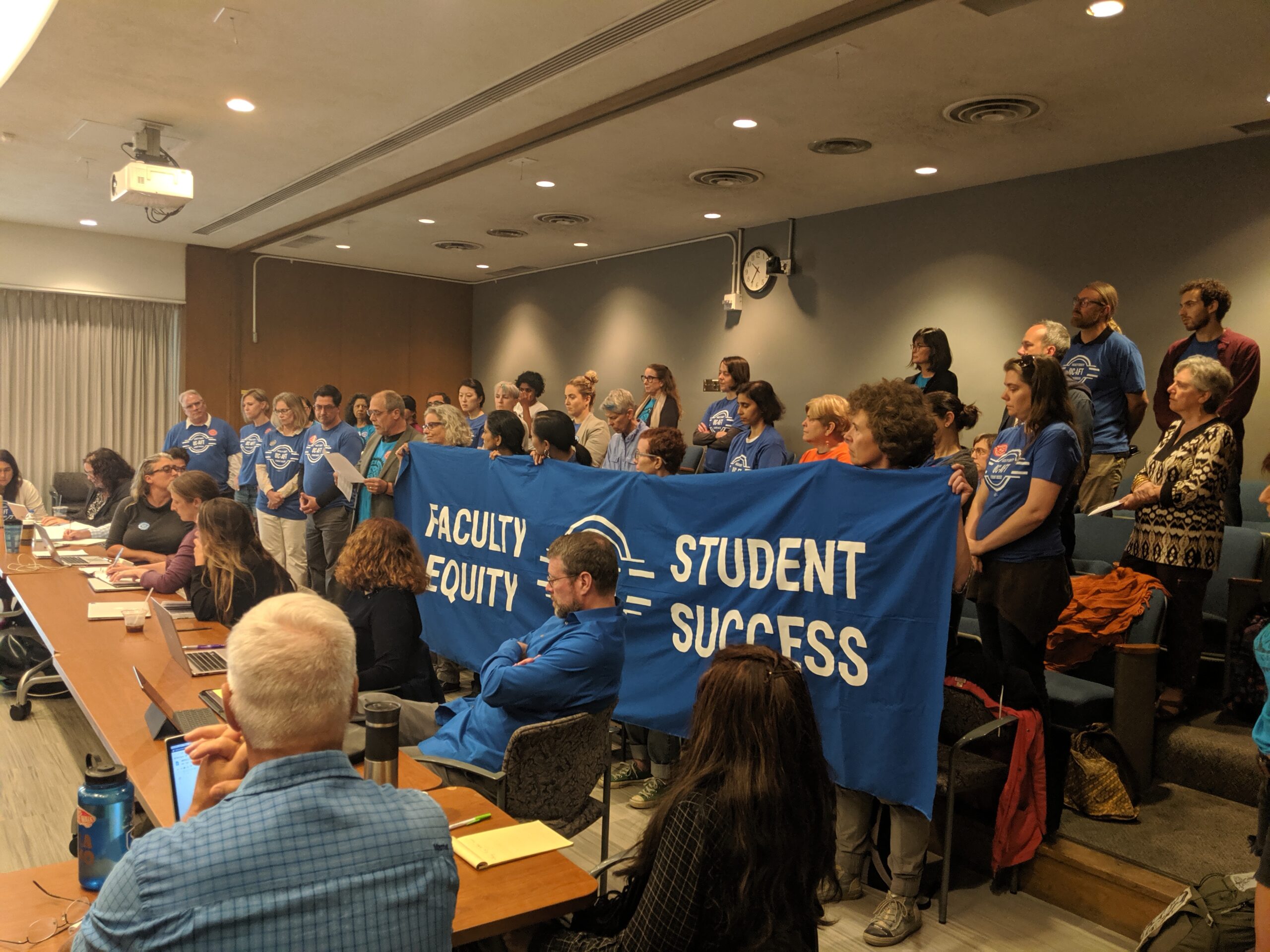
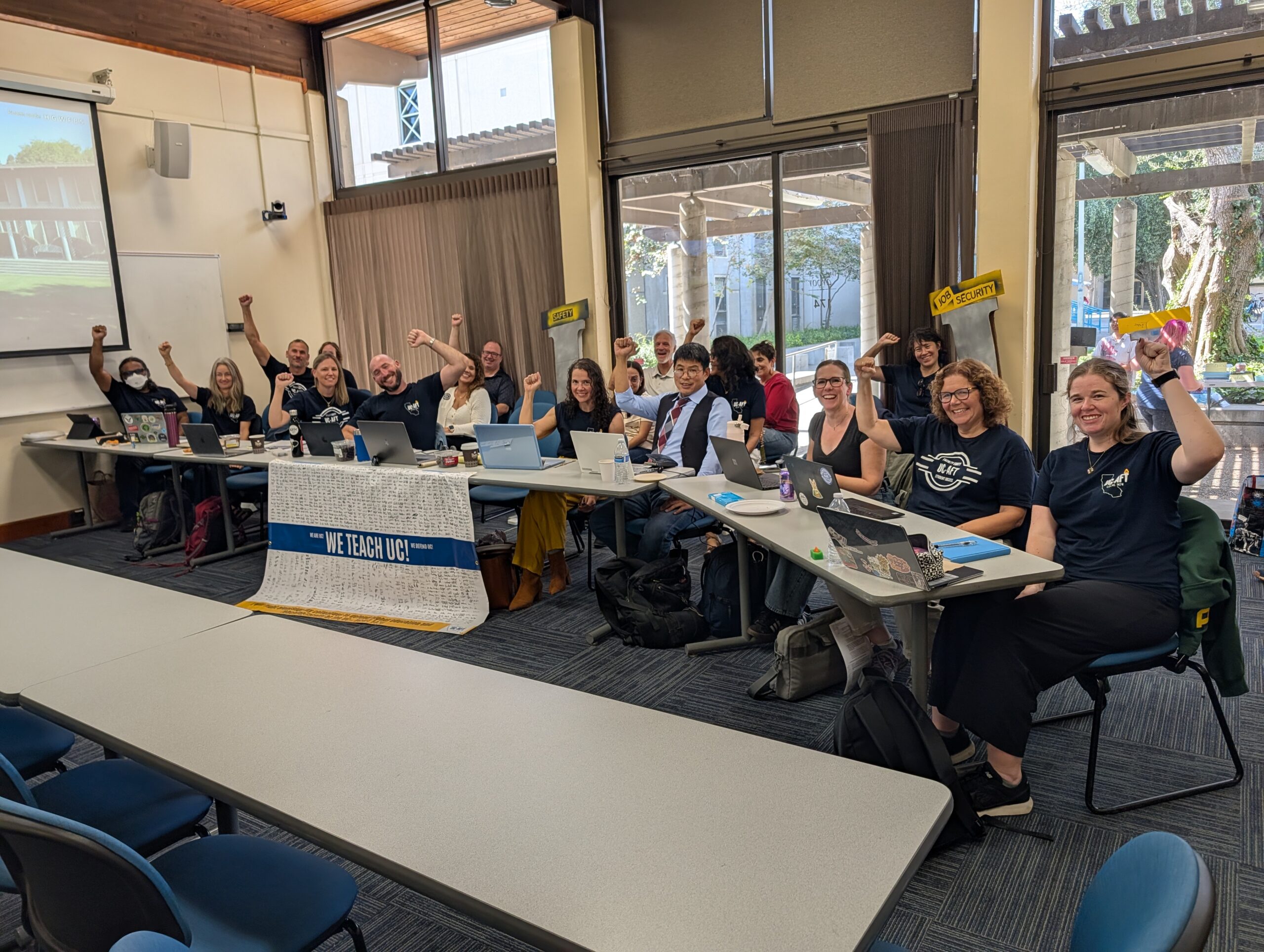
Your UC-AFT Table Team gathered in a packed conference room at UC Davis for another bargaining session on Thursday, Sept. 24. The biggest item on the agenda was workload (Article 24), with nearly a dozen UC-AFT members from UCD and UCB speaking about reductions in their appointments and the uncompensated labor they are regularly asked to perform, in addition to proposals on Instructional Support (Article 8), Layoffs (17), and Health and Safety (43). A clear theme emerged over the course of the day: classroom teaching at the UC has changed significantly since our last contract fight, and UC-AFT teaching faculty are fighting for proposals that will make our jobs more stable, better-resourced, and less administratively onerous so that we can deliver the high-quality education our students deserve.
Fair Workload Now!
The UC consistently devalues the work of its teaching faculty, which impacts many other aspects of our lives. While our current contract establishes that a full-time workload for lecturers cannot exceed 9 classes per 3 quarters (6 per 2 semesters), the way UC evaluates our workloads means that less than 20% of lecturers have full-time appointments and 56.6% of teaching faculty don’t have access to healthcare and benefits. Some teaching faculty make less money than their teaching assistants and much of the work we do – writing letters of recommendation, serving on departmental committees, developing new curriculum, etc. – is uncompensated. Undervaluing our labor also impacts our salaries: the average UC lecturer is making between $28,000 and $38,000 per year, forcing many lecturers to take on additional jobs to afford the rising cost of living in our campus communities. And because the most underfunded departments (where the majority of teaching faculty tend to be women and BIPOC folks) often have the highest workload thresholds, we do not have equal work for equal pay.
These themes echoed through the powerful testimonies of UC-AFT members in the morning session. Members from a variety of departments with very different classroom experiences offered compelling examples of how the work they do goes unrecognized and uncompensated. Rebecca Rosa, from the Teacher Education program at UCD, explained how the demands of her program – which includes field observation at multiple schools across the district, reviewing lesson plans, and giving one-to-one feedback – can mean teaching faculty spend nearly 30 hours per week outside of the classroom, even as they are compensated as part-time faculty. Michael Ball, who teaches in the EECS (Electrical Engineering and Computer Science) Department at UCB, testified about the EECS “Heaven Point” workload evaluation system, which has not been updated since the 1980s. By his calculations, under this workload formula, he has given about 1 year’s-worth of free labor to his students and his University, relative to other colleagues.
Student needs have changed with increasing numbers reporting disabilities, food and housing insecurity, and mental health challenges, including higher rates of ADHD, anxiety, and depression;
Faculty perform “invisible” labor in navigating these student challenges in their teaching, including increased accommodation authorizations without any additional support;
This “invisible labor” is not shared equally. Faculty of color and women experience higher workload in mentoring and advising students;
There has been an increase in the use of educational technology (e.g. Canvas) and in student expectations of multimodal instruction and instructor responsiveness, which puts additional demands on teaching faculty;
While the hype around generative AI promises to reduce workload, generative AI has dramatically increased workload for higher education faculty.
Lecturers in departments from Sociology to Journalism to Human Development and languages added testimony about how much their work has changed in recent years. Their testimonies made it plain to the UCOP negotiators: we need fair workload standards now.
Our Proposal on Article 24: Empowering Teaching Faculty
As reflected in the morning’s testimony, as well as countless discussions with members and multiple bargaining surveys, teaching faculty workloads vary across departments and campuses and are inconsistent, inequitable, outdated, and non-transparent. UC-AFT teaching faculty include dentists, musicians, supervisors of teacher education, studio artists, legal clinic supervisors, and nurses, making it nearly impossible to define one workload standard that takes into account all the ways we teach. Our current workload article sets the maximum workload for all lecturers at nine instructional workload credits (IWCs) per year (six at semester campuses), but gives the UC unilateral control in determining what constitutes one IWC, offering little recourse to lecturers whose classes are weighted wrongly.
Our proposal would fundamentally change how IWCs determined by:
Redefining a full workload as 6 IWC per year, rather than 9 (or, for semester campuses, 4 IWC rather than 6), and setting a standard calculation of 1 IWC per course, to create more equitable workloads for all;
Returning control over determining workload standards to departments and giving lecturers a seat at the table in those determinations;
Clarifying what can be considered in determining IWCs and how courses can be considered more than (or occasionally less than) 1 IWC;
Adding specificity for IWC calculations for supervisors, music, and other job titles;
Adding an overload provision that allows teaching faculty to choose to accept additional classes even if it puts them over 100% appointment;
Requiring additional transparency around departments’ workload policies, as well as regular workload reviews and recalculations;
Creating new mechanisms for remediation when teaching faculty believe their IWC calculations do not reflect their actual workloads.
Our proposal would replace the current, all-too-complicated top-down formula, with localized decision-making, adding fairness across the system and creating more equitable workloads for all.
After a break for lunch, UC-AFT presented its proposals on another article that impacts our workloads: Article 8 – Instructional Support. UCOP’s representatives seemed totally unaware of just how degraded our classrooms have become in recent years, as threats to campus safety have increased and support services have been cut. Through additional testimony, UC-AFT leaders made it clear that our facilities lack the reliable internet and cell phone service, display equipment and adapters, safety features, and ADA accessibility we need to do our jobs. Our proposal on Article 8 would codify these requirements and provide teaching faculty with stipends to purchase necessary materials of $400 per course for materials and $1500 annually for computers and other classroom technology.
UCOP’s representatives also seemed not to realize how UC’s steep cuts to graduate education have impacted our working conditions. Our graduate colleagues fought hard for the improved compensation they won in their last contract, but instead of increasing funding to cover these new costs, campus administrators have required departments to reduce the number of Academic Student Employees, with Unit 18 faculty often bearing the brunt of the cuts. Our proposal would establish equity with senate faculty in terms of the number of ASEs assigned to our courses and explicitly protect us from being forced to pick up struck work.
Later in the afternoon, our table team also presented a related proposal on Article 43 – Health and Safety. Once again, members spoke to the new threats to our classrooms that have emerged in recent years, including those related to the ever-growing impacts of climate change. As an increasing amount of our teaching occurs online, UC-AFT members have faced doxxing attacks from online mobs, often including physical threats to their safety, as well as unwanted surveillance in their classrooms. UC Davis was a fitting setting for the discussion: in recent years, Davis has been repeatedly blanketed in toxic smoke from wildfires, temperatures consistently reach over 100 degrees, and in 2023, the campus was besieged by a series of stabbing attacks that left two people dead.
In the face of these new 21st century threats, our table team is proposing to expand Article 43 in ways that will better enable us to maintain safe environments in our classrooms, both in person and online. This includes a new provision that will give Unit 18 teaching faculty the discretion to decide when an emergency on campus warrants a temporary modification to their courses.
“Working at UC can be a great job, unless you’re in constant fear of losing it”
Among the central priorities of our contract campaign is to establish true security of employment. This goal stretches across several articles in our contract, including the 7s (Articles 7a, b, c, and d), which outline the structure of our appointments, as well as Articles 22 and 31, which outline Merit and Academic Review Process. On Sept. 24, our table team put forward its proposal on another important aspect of our job security: our protections around layoffs, as outlined in Article 17.
UC-AFT members have pressed the urgent threat of layoffs at every one of our bargaining sessions with UCOP so far. Colleagues have shared heartbreaking stories of the impacts that layoffs have on our families and our students, particularly at UC Merced, where 25% of our bargaining unit was laid off as a result of the university’s “budget stabilization plan.” UC-AFT has since filed an Unfair Labor Practice (ULP) charge challenging this unlawful, unilateral change in our working conditions.
Our proposal on Article 17 aims to prevent these kinds of layoffs from happening again. It aligns the article with our proposal on 7a, which will do away with the reappointment process by establishing open-ended, fully-funded appointments for pre-6 lecturers. It limits the reasons for a layoff and prohibits the kind of mass layoffs that occurred at UCM. Pre-continuing Unit 18 faculty would no longer be able to be laid off for unspecified “lack of work” and our courses would no longer be reassigned to Senate faculty or graduate students. Layoff/RITs would only occur if there is a documented budget shortfall, and the notification times for layoffs would be extended. The proposal also will close existing layoff loopholes and strengthen lecturers’ rights to due process when their courses are cut and/or academic programs are closed. In combination with our other job security proposals, our proposal on Article 17 aims to bring an end to our precarity.
In the past two sessions, our Table Team has offered nearly a dozen substantive and transformational proposals on key articles to move us towards our mutually-agreed upon Dec. 1 deadline as quickly as possible. Our efforts have focused on the key priorities of our members and tackled the biggest challenges we face as UC teaching faculty. But UCOP has thus far refused to offer any substantive responses, including our proposals on job security (7a), technology in the classroom (44), or academic freedom (Article 2), which we offered at our first session back in March. Instead, they have offered modest changes to less structurally significant parts of our contract that largely protect the status quo. That tendency to avoid addressing our major concerns was reflected in the session at Davis, where they offered only one new proposal on Article 41 – Parking.
The rising costs of parking certainly impacts UC-AFT members, as do the skyrocketing costs of gas and other staple goods. But even as UCOP’s negotiators recognized that “the world is getting more expensive,” they are proposing to increase the previously-negotiated caps on parking fees that lecturers must pay. As table team member Kat Lewin noted, they are, in effect, “trying to recoup funds from a group of people who can’t afford to live near the University,” imposing new financial penalties on already underpaid lecturers who are denied access to the housing support they offer tenure-track faculty and forced to negotiate an increasingly hostile rental market.
Join the Fight for Faculty Equity: Oct. 8 at UC Riverside
What has become abundantly clear in these last two bargaining sessions is that if we want UCOP to take our demands seriously, we must demonstrate our will to win them. Now’s the time to get involved – join our fight for the UC we deserve!
Our next bargaining session will be at UC Riverside on Oct. 8, starting at 10am.Join your colleagues at INTS 113 – RSVP!
Amidst a scorching summer heat wave, UC-AFT members gathered at UCSD on August 27 for our third bargaining session of the summer. The agenda was jam-packed: We brought six article proposals to the table, focused on the issues UC-AFT members identified as top bargaining priorities, including:
job security
protections from workplace discrimination, abuse and retaliation
support and protections for faculty on non-immigrant visas
access to benefits
Together, these proposals lay out the kind of UC we are fighting to build: A UC where Unit 18 faculty can build stable, sustainable careers. A UC that protects its most vulnerable members and actively fights discrimination and abusive conduct. A UC that takes care of the people who take care of it.
Merced Layoffs: UC says move on. We say fight back.
The session started with heartfelt testimony from Helen Sandoval, a former Continuing Lecturer whom UC Merced laid off in 2025, after twelve years in the Merritt Writing Program.
“I built a life there with my family, three little boys. Many of my colleagues had built their lives there,” Helen shared. “We get this notice. So we’re asking ourselves why… Why me? Is it me? What did I do? What’s going on here? Why, after 12 years—just questioning. You can imagine how difficult it was.”
Helen ultimately was able to find a position at UCSD, but the layoff cost Helen her Continuing Lecturer status, and forced her to uproot her family, and move to an area with dramatically higher cost of living and an hour-long commute to campus.
“Everyone felt like family,” Helen said of her former program. “And then to be treated like that was very difficult. It’s still difficult.”
Helen is not alone. In UC Merced’s Merritt Writing Program, 25% of our fellow teaching faculty received layoff noticesin 2025. This spring, another 10%received notices.
UC is well aware of this issue. We have raised the Merced layoffs at nearly every bargaining session since April.
While bargaining can help us win stronger protections against future layoffs, members are also fighting back against the harm already done. On August 27, UC-AFT filed Unfair Labor Practice (ULP) charges alleging that UC Merced unlawfully restructured its budget “to make mass layoffs of Unit 18 lecturers an inevitability.”
We deserve fair treatment, not just federal minimums
UC administrators claim they prioritize protecting our rights and the rights of our students, but too often they refuse to exceed the bare minimum protections required by law.
Our proposal on Article 4: Non Discrimination in Employment moves beyond bare-minimum “non-discrimination” and toward actively confronting discrimination and inequity. We proposed expanding protected identities, addressing barriers to promotion and employment, and requiring UC to identify and address and identify systemic barriers and inequalities.
We also proposed protections against abusive conduct and retaliation—two glaring holes in our current article—along with stronger and more timely grievance processes, and requirements that UC actually meet its own deadlines for investigating discrimination and abusive conduct.
Rights on paper are not enough when workers are too afraid of retaliation to report discrimination or misconduct, or when people who do report discrimination or harassment are trapped in investigations and grievance processes that drag on for months or years.
Our UC-AFT table team also proposed major changes to Article 34: Immigration Reform and Control Act, strengthening support for Unit 18 faculty on non-immigrant visas. Our proposal would improve protections around work authorization, expand immigration and legal assistance, support H-1B visas and permanent residency, and strengthen protections against immigration enforcement.
UC Irvine table team member Shannon Alfaro introduced the proposal with anonymized testimony from multiple Unit 18 faculty whose lives and careers have been upended by current UC policies and administrative failures, including visa instability, lost housing and income, and family separation.
In one shocking example, a lecturer lost an entire academic year of teaching and their apartment. And to top it off, UC then required them to fly from Europe to California for a single day to sign a form … electronically … through DocuSign.
We know that UC can do better, because other universities already do. Many of our proposed protections are modeled on provisions already won at peer universities. We call on UC to meet that standard.
For more details, see the full Article 34 proposal here.
Clear, fair reviews mean real career paths
Merit and promotion review practices can vary dramatically from campus to campus and within divisions and departments—making career advancement confusing and unfair decisions harder to challenge.
Our proposals on Articles 22 and 31 would make these processes clearer and more consistent, strengthen pathways to Continuing Lecturer and Senior Continuing Lecturer, expand protections against arbitrary or discriminatory review decisions, prohibit the use of AI in review decisions, and increase raises for successful merit and promotion reviews.
These proposals complement the other job security proposals (including on articles 7a and 7b) that we have already brought to the table. Our goal is simple: Unit 18 work should be a career, not just a job.
University Benefits for Those Who Benefit the University
We need reliable access to affordable benefits, or our jobs are simply not sustainable.
Many UC-AFT members struggle to access basic benefits like Social Security or healthcare, and those who do qualify for health insurance have suffered skyrocketing premium increases in recent years. And many of us cannot afford to live in the communities where we teach. Even when campus housing benefit programs do exist, Unit 18 faculty often are excluded or kicked to the back of the waitlist behind Senate Faculty.
Our proposal on Article 11: Benefits would make all Unit 18 faculty eligible for Social Security, extend access to healthcare eligibility, limit health insurance premium increases over the life of the contract, and make Unit 18 faculty eligible for all campus benefits offered to Senate faculty.
At the bargaining table and beyond, we will press the point that UC should take care of the people who take care of it.
At the June 4 bargaining session, UC proposed adding “presumptive resignation” to our contract. This would be a new mechanism that could treat faculty as having resigned if they are out of contact with the University for a week. UC’s chief negotiator said it was intended to “address a ghosting situation, as the kids say.”
While UC-AFT has spent months proposing ways to make Unit 18 careers more secure, one of UC’s biggest proposed changes would make it easier to lose your job.
We rejected it.
UC also presented two proposals this session: Article 12 – Leaves and a new article on Paid Sick Leaves, which they claim will “dramatically expand” paid sick leave for Unit 18 faculty. We support that goal. Now we’ll review the language and make sure the proposals actually deliver on it.
What’s next? September 24 Bargaining at UC Davis
This summer, your table team negotiated a one-year contract extension that gave us more time to push UC at the table, and secured UC-AFT members a 4% raise. (Check your September 1 paystub to ensure you received yours!)
The extension also requires both sides to submit all initial article proposals by December 1, 2026. So expect action-packed bargaining sessions and plenty more bargaining news, as we put members’ priorities on the table and find out what UC is willing to offer.
Our next bargaining session is Thursday, September 24 at UC Davis. Bargaining will take place at School of Education 174 from 10:00am – 4:30pm, with a rally at noon at the courtyard outside. Come watch the fight from the front row and show UC that the people behind our proposals are paying attention.
Future bargaining sessions are also planned for October 8 (potentially at UC Riverside) and November 5-6 (potentially at UC Merced). Now’s the time to get plugged in on your campus and get involved.
We secured a contract extension with a 4% salary increase (details below)
Your Table Team continued to push UC to accept open, accessible, and affordable Zoom bargaining
Lecturers from UC Santa Barbara testified to the excellence and importance of their work, preparing the ground for our upcoming proposals on workload and compensation
UC-AFT and UCOP made progress toward tentative agreements on previously proposed changes to the contract
This Bargaining Update is a follow-up to our previous update about the two-day bargaining session that took place at UC Santa Barbara on July 15-16. In that email, we shared the news that our Table Team won a 4% salary increase in exchange for a one-year contract extension. Please note: that 4% increase will begin on August 1 and should show up in your September paycheck, so contact your campus rep if you don’t see it there. Your Table Team was hard at work on July 15-16, so we’ve offered a longer update here.
On the first day of bargaining at UCSB, the UC-AFT Table Team and reps from UCOP returned to the question of ground rules and zoom bargaining once again. Having initially proposed a cap of around 475 participants and observers on Zoom, UCOP offered a revised proposal to reduce the cap to 25, then another revision to 100. This time around they budged slightly, offering a cap of 125 people in the Zoom room, which would include UCOP’s team, our Table Team, and observers from across all UC campuses. UCOP clarified their reasons for restricting observers: “We don’t think it’s a spectator sport … the notion that a lot of people would be watching who don’t have involvement … that concerns us.” We held steady, insisting again that bargaining with a public institution should be a public process, and concluding that an observer cap of 475 would allow Unit-18 lecturers and other stakeholders from across all campuses to attend Zoom bargaining and witness bargaining firsthand. UCOP did not agree, so bargaining will remain in-person for now and we will continue to push for open Zoom bargaining.
Our Testimony to UCOP
In the two days of July bargaining, UC-AFT members delivered powerful testimony to UCOP that underscored the stakes of our fight for faculty equity.
Emiko Saldívar, Continuing Lecturer in Anthropology who has worked at UCSB for 18 years, testified to the outsized role that lecturers play in departments due to our high workloads, noting the disconnect between our importance to our students on the one hand and a lack of support from the UC on the other. In the upcoming year, UCSB’s Anthropology department will teach 985 students. Emiko alone will teach roughly 560 of them — more than half the department’s students — across 9 of its 18 courses. At the end of the day, Emiko reflected, our workloads don’t enable us to connect with students to a degree that we’re capable of, and that they deserve. Nor do our salaries reflect the work we do. “I’m basically the face of the department. I get paid half of what my colleagues do.”
Additionally, Emiko spoke to the ways that Unit-18 Lecturers are penalized for going above and beyond, telling of a time that she won a grant for her students to travel and do research with Indigenous populations, necessitating time away from teaching on campus. Emiko took a workload and pay cut so she could voluntarily do scholarly work that greatly enhanced the academic mission of UCSB, which the Dean of Social Sciences lauded as an example for the future of the university. Despite her research being given such praise, the university did not restore Emiko’s appointment and salary to 100% after the project was completed, effectively punishing her for her dedication to her students. Emiko’s takeaway: “This is how we endure. We get no respect, we don’t get paid for research, but our teaching has to be of research-quality. We need less workload so we can actually prepare and be there for our students.”
Emiko’s sentiments were echoed in testimony from Sarah Holmes, who teaches Dance History and Appreciation, a General Education course that introduces nearly 500 students to dance as a way of understanding history, culture, identity, politics, creativity, and ultimately, what it means to be human. Sarah came to UCSB after earning three graduate degrees and building a career as an educator, artist, researcher, and curriculum developer, and completely redesigned the course. But her salary is more than $20,000 below living wage estimates for Santa Barbara County, requiring her to work three additional jobs on top of managing her chronic illness. “Imagine what I could contribute if my professional energy could be devoted entirely to UCSB,” she said to the UCOP reps. “Imagine the students I could mentor. The grants I could write. The research I could expand. The new courses I could develop. The partnerships I could build. The service I could provide to my department and university. Instead, much of that energy is spent simply trying to make ends meet. That is not only a loss for me. It is a loss for my students. It is a loss for this institution.”
We know that too many Unit 18 faculty live and work under the trying conditions that Emiko and Sarah described. Improving workload and compensation are key bargaining pillars that UC-AFT members voted for, which continue to guide our proposals and negotiations with UC. Sarah captured our demands perfectly in her testimony:
“We are not asking for luxury. We are asking for dignity. We are asking for stability. We are asking for compensation that allows us to live in the communities where we teach. We are asking for careers that allow us to devote our full professional lives to our students instead of dividing our attention among multiple jobs simply to survive. Every day, I ask my students to imagine a better future. Today, I am asking the University of California to imagine one for the educators who dedicate their lives to creating theirs.”
What UCOP Proposed to UC-AFT
UCOP presented several proposals to UC-AFT over the course of the two-day session. Our Table Team also sought to clarify language on their previous proposals, including Article 7 – Appointments – and pushed back against “Presumptive Resignation” language that UCOP proposed in Article 18. We raised concerns that the contract language would enable UC to sever any U18 faculty member who was absent and unresponsive for 7 days under the assumption that they had resigned.
UCOP first offered their counter proposal on Article 14 – Holidays. UC-AFT’s Table Team had previously passed a proposal that would add a provision to the article giving U18 faculty the flexibility to make reasonable schedule adjustments or alternative arrangements to observe religious, cultural, spiritual, or community holidays or observances not included in the University holiday calendar. Our proposal is modeled on concepts in the contracts for Academic Researchers, Post-Docs and Librarians, but adjusted to accommodate the nature of Unit 18 appointments. The changes we’re proposing are designed to ensure that teaching faculty can observe holidays of their choosing without loss of pay, adverse employment consequences, or unnecessary workload increases.
UCOP countered with a proposal that accepts our concept, with slightly different language. Their proposed language would allow unit 18 faculty members to request time off to observe religious holidays and states that such requests would be granted unless doing so would “create an undue hardship” to the university. Your Table Team will review the counter proposal more closely but it seems like a step in the right direction towards an agreement on the article!
The next proposal offered by UCOP was on Article 25 – Union Rights. This article is quite technical, but crucial to establishing UC-AFT’s right of access to campus facilities and personnel information, among other things. UCOP’s proposal includes minor technical updates to language in this article, including a clarification about appropriate avenues for alleging violations of our contract. While our grievance process is outlined in a separate article (Article 32), those changes raised some concerns, prompting Table Team members to ask important clarifying questions about whether their proposed changes might conflict with the grievance process and the PERB process, thereby delaying resolution. For these reasons, your Table Team will plan to offer a counter-proposal.
Finally, UCOP offered proposed changes to Article 42 – Online Instruction, an article that has become increasingly important to our working conditions since our last contract fight. In bargaining surveys and previous negotiation sessions, UC-AFT members have made it clear that when it comes to online education, we prioritize protecting our rights to determine what’s right for our classrooms and to protect the quality of education. This is true when it comes to any use of technology in our classrooms, which is why we’ve offered our proposal for a new technology article (read more about it here). UCOP claimed their proposal offers minor clarifications, rather than substantive changes, but our Table Team was not so sure. We will be reviewing their proposal in detail and will likely be offering a substantial counter proposal.
After presenting their proposals, UCOP asked some questions about our Article 7 proposals related to the differences between appointments and reappointments and after a short caucus, the two-day session was complete.
Next Session: August at UC Merced???
As described above, our UC-AFT Table Team is fighting hard to establish ground rules for Zoom bargaining that maximize member participation. But we were not able to reach an agreement with UCOP. In the meantime, we are working with UC to finalize dates for in-person bargaining in August and September. Our next bargaining session will likely take place in August at UC Merced. Stay tuned for more details as soon as we have them!
We are getting very close to a tentative agreement (TA) on ground rules; our table team continues to fight for maximum Zoom participant numbers to support membership observation of bargaining sessions.
UC-AFT and the UC agreed on a short-term contract extension, which will remain in effect until 11:59pm on July 16.
The table team will return to bargaining at UCSB on July 15-16, providing two full bargaining days to work toward a longer extension with acceptable terms, ground rules, and other proposals. (RSVP now to show your solidarity!)
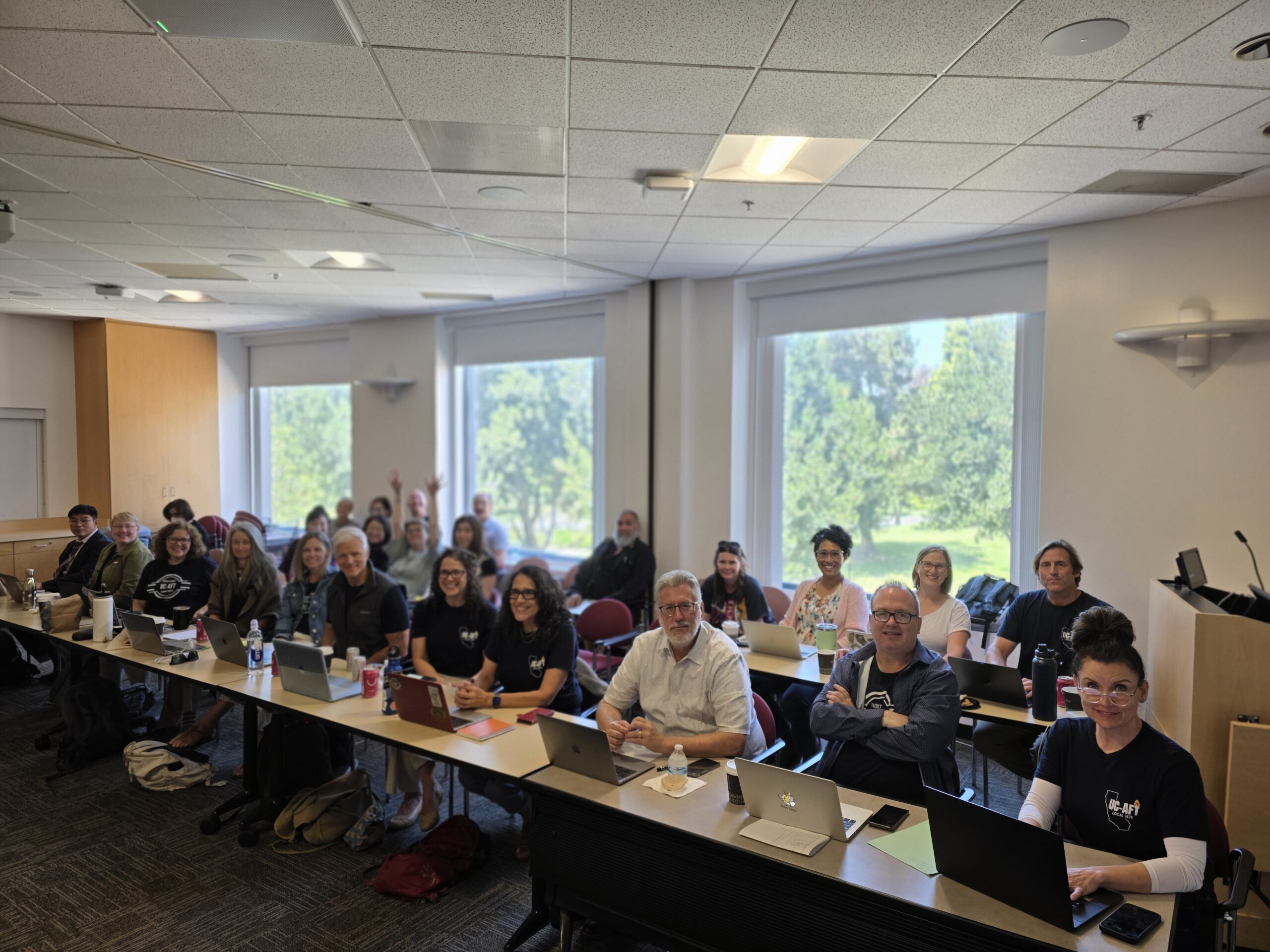
Our UC-AFT Unit 18 Table Team was joined by lecturer observers and supporters from UC Davis and UC Berkeley when we came together for another contract bargaining session at Bauer Wurster Hall on June 30 in Berkeley.
The Table Team had a very productive work session where we focused on technical aspects of the contract, including movement toward reasonable ground rules for Zoom bargaining and consideration for a contract extension. The table team did the hard work of conceptualizing and passing two extension proposals, and ground rules counterproposals.
UC-AFT Proposal on ground rules
Over the course of the day, UC-AFT and UC exchanged three counterproposals over ground rules – coming very close to agreement. We made significant progress toward establishing a consistent rotation between in-person and Zoom bargaining sessions. As of the end of day, there is one final key point of disagreement: the total number of observers permitted in the virtual room during Zoom bargaining. While the UC proposed a cap of 100 observers, the table team is holding strong on permitting 475 observers. (We note that UC and UC-AFT had mutually agreed to this cap of 475 for months – until on May 7, UC shockingly revoked their agreement, and proposed a cap of 40 – a limit barely high enough to accommodate both bargaining teams.)
UC-AFT is committed to keeping bargaining open and transparent to members. UC-AFT’s co-chief negotiator Kat Lewin said to the UC’s team, “We know that power on your side of the table flows up to the Regents. Our power flows down to 5,300 people who will ratify the contract. It’s important for them to understand the contract if they’re going to ratify it.”
Another issue is ensuring accessibility to bargaining sessions for members with disabilities, which broad Zoom observation can help address. Kat explained to UC negotiators that an arbitrary cap on the number of Zoom observers reduces the ability to participate in bargaining overall, particularly for members with disabilities that outright prevent or limit them from joining in-person negotiation sessions.
UC Proposal on Summer Session
UC passed their initial proposal on Article 23 – Summer Session. UC’s proposal included two substantive changes to the article:
Adding new procedural requirements for lecturers who want eligible Summer Session teaching to count toward service credit for Continuing Appointment. Under UC’s proposal, requests would have to be made in writing by the end of the next academic year.
Changing the language on Health & Welfare Benefits eligibility during Summer Session. UC says their proposed changes are intended to align the contract with current UC benefits practices.
The Table Team is reviewing the proposed language carefully to evaluate how such language would impact members across our bargaining unit.
Contract Extension Proposal and Counter
The Unit 18 contract was set to expire at 11:59pm on June 30, 2026.
For those of you who aren’t collective bargaining junkies, FYI on contract expiration: Contract expiration does NOTmean that we have no contract or that our terms and conditions of employment disappear. If and when the contract expires, UC is generally required to maintain the status quo, and cannot simply make unilateral changes to our terms and conditions of employment.
The main differences, if we are out of contract, are that our ability to move some grievances to arbitration may be limited while the contract is expired. And while the contract is expired, in certain circumstances after legal pre-requisites are met, UC-AFT gains the ability to strike.
During the session, UC initially offered a proposal for an extension until September 30, 2026. The terms of their proposal offered no benefit to members.
UC-AFT responded with a counterproposal to extend the contract until November 16, 2026 – along with increased layoff and reduction-in-time notice periods for the duration of the extension, and a 5% salary increase.
Our table team pointed out that without additional compensation, UC-AFT lecturers are going to lose significant financial ground due to inflation and the increasing costs of living in California. The table team communicated that the fundamental goal with our 5% compensation proposal is to support a baseline cost of living increase for members while we continue to negotiate. And as Table Team member John Haner (UCM) firmly pointed out, University of California Office of the President recently announced that non-represented academic appointees and policy-covered staff will receive a 4% salary increase as of July 1.
The UC expressed surprise that UC-AFT had proposed a compensation increase in exchange for a five-month contract extension. However, such a practice aligns with what sibling union CIR-SEIU won for a 1-year extension in their recent contract negotiations. At the table, the UC communicated that their team was not prepared to agree on any terms regarding wages as part of a contract extension, and would need more time to negotiate the intricacies of a proposal that involves wages.
UC-AFT suggested the UC put their money where their mouth is: We proposed an extension until 11:59pm, on July 16 – the final day of our next bargaining session – and told them we hope they come prepared to discuss wages as part of a longer-term discussion. Come to our next bargaining session at UCSB to see if they use this time to bring back a contract extension proposal that meaningfully responds to our concerns.
Next Bargaining Session: July 15-16 at UCSB
The UC-AFT Table Team will continue contract bargaining over two full days at UC Santa Barbara on July 15 and 16. Members can RSVP now to show your solidarity in person at UCSB in just a few weeks!
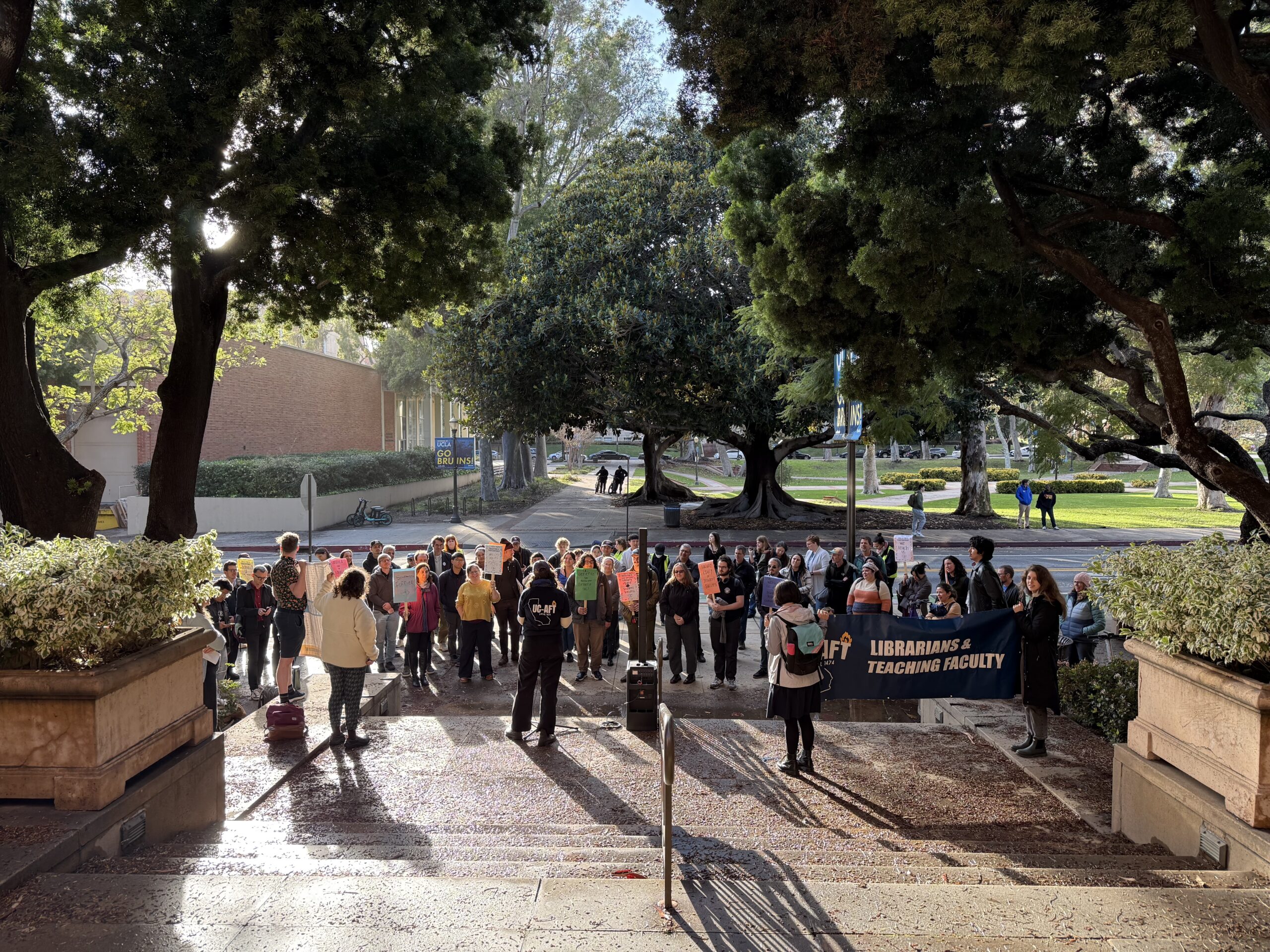
After powerful testimony about the devaluation of our labor, UC-AFT members held an energetic rally with members of UAW 4811, AFSCME, UCSC Faculty Asso, and student allies.
We passed our proposal on Article 35, which would enshrine our right to free expression in our no strikes / no lockouts clause;
UCOP proposed modest changes to Articles on Resignations (18) and Medical Separation (16).
Our UC-AFT Table Team kicked off its bargaining session at UCSC on June 4 by following up with UCOP about layoffs of language lecturers and UC’s threatened shift to online instruction through the Global Languages Network (GLN). When asked for a justification of the GLN, UCOP reps claimed that its purpose is to preserve language instruction which would otherwise be canceled due to low-enrollment, moving classes online where they might attract more students across UC campuses, and to incorporate AI as “a tool, not the sole instructor.”
Table Team member Alison Lipman refuted UCOP’s claim, arguing instead that many canceled language classes from across UC have been fully enrolled, popular courses and invited UC-AFT members to testify to that fact. Tonia Prencipe, lecturer in Italian who has taught at UCSC for 30 years, spoke about Italian 101, a class she teaches that routinely fills to its 50 student capacity. She’s received no answer as to why it has been cut but clearly “low enrollment” is not the cause. Stephanie Lain, continuing lecturer in Spanish at UCSC, pointed to a recent policy that arbitrarily prevents lecturers from teaching upper-division courses, including her upper-division course, “Society and Sustainability in Latin America,” which she was the first to develop and teach. “By attempting to deprofessionalize our work,” Lain said, “the administration moves one step closer to eliminating our lecturer job title.” I Ju Tu, lecturer in Chinese, added that her recent reappointment reduced her previous 8 courses to just 2, resulting in a 75% cut to her income and the loss of her health insurance. Her other courses didn’t disappear, they were reassigned to another, less experienced lecturer and a senate faculty member, suggesting her 75% reduction in time was a restructuring project dressed up as a staffing choice.
The morning’s testimony highlighted the importance and popularity of language lecturers at UCSC, where the administration has eliminated German, Italian, Arabic, and Farsi, while instituting severe cuts in Spanish and French. The lecturers who taught in these programs had developed original, well-enrolled language classes that went above and beyond. Prencipe, for example, created a meaningful study-abroad program for UCSC students on the Amalfi coast to offer cross-cultural immersion. Lain taught students Spanish by teaching them about sustainability in Latin America, an understandably popular topic at UCSC, and Tu’s courses familiarized American students with the cultures of China, while providing international students a place to be in-community far from home. All were well-enrolled and contributed not only to the mission of the UC, but also to the International and Global perspectives fundamental to UCSC’s College Nine, where bargaining was held. As senate faculty member Maria Davis stated in her testimony about the importance of language lecturers, “We are in a room with a lot of flags … living in a moment of xenophobia and racism.” The courses that lecturers design and teach are a bulwark against this contemporary closure of the American mind, a ray of light in dark times, a source of multilingualism amidst a turn away from the world community.
Flags adorn the ceiling of Namaste Lounge, where bargaining was held at UCSCs College Nine. Ironically, much of the day’s testimony highlighted UC’s turn away from language instruction and global community.
A second set of testimonials continued the emphasis on UCOPs devaluation of the labor and dignity of teaching faculty. Jared Gampel spoke to his 20-year experience at UCSC – first as an undergraduate, then graduate student, and now lecturer – about the ways that the UC overworks lecturers and graduate students alike. Gampel’s transition from a graduate student to a lecturer has meant he isn’t able to do the research and writing he was trained to do and resulted in a pay cut per class taught. The UC system and UCSC, Gampel noted, has “devalued labor and, as a result, my life.”
Lecturer Amanda Reiterman began her testimony short of breath after running from class to get to the bargaining table. Noting that she had recently been laid off from teaching Latin she spoke to the importance of that class, pointing to a computer science undergraduate who told her his reason for taking Latin was, “to make friends…. he was lonely.” This anecdote points to the difficult to quantify value of languages and the humanities where students look for smaller courses with more human connection. When lecturers like Reiterman who teach courses like Latin are laid off, this student reminds us, we don’t only lose amazing lecturers; we lose the kind of courses that actually build community on campus, lead to student retention, and sustain us as individuals and campuses alike. In light of persistent cuts to languages and humanities, Reiterman likened the vibe on campus to “the last days of the Roman Empire.”
Christie Mccullen, continuing lecturer in sociology who designed and teaches a course on the Sociology of Postpartum spoke to the sorry state of UCOP’s parental leave and childcare policies when it comes to teaching faculty, noting that we receive far less support than do our graduate student instructor and senate faculty colleagues.
Taken together these testimonials point our way forward. Against austerity measures aimed at sinking the humanities, against the layoff of lecturers and against AI driven “education” that alienates students and undermines retention. In turn: for rich, rewarding education where “the learning process can be slow and immersive … the antidote to shallow knowledge,” as Reiterman described. She ended her testimony with a plea to UCOP that informs what we’re fighting for in our contract campaign: “Find your soul again UC. Your students deserve that.”
No Strikes clause – “Decent humans don’t cross picket lines”
Our table team also used the day’s bargaining session to present our proposal for new language concerning Article 35, known as the “No Strikes / No Lockouts” article. Josh Brahinsky, lecturer in UCSC’s John R. Lewis College, introduced the topic with our last testimony for the day. He spoke powerfully about the injury to conscience that arises for so many of us each time one of our sibling unions goes on strike and we are compelled to engage in business as usual. In these cases, Brahinsky noted, “I’m being asked to teach when it’s an absolutely unethical thing to do,” proclaiming that, “an injury to one is an injury to all.” If our constitutional and human rights are to remain meaningful, and if we are to maintain good relations with our students who are looking for ethical and principled teachers, then we ought to have a contract that recognizes and enshrines our ability to follow our consciences, Brahinsky said, adding that decent humans that “don’t cross picket lines.”
At this point table team member Joseph Klett presented our proposal on Article 35. The changes the Table Team proposed would address the shortcomings of the current contract by making explicit the fact that teaching faculty retain our rights to free expression and can act on their own conscience without fearing disciplinary measures from the administration. It specifies that in the event that our sibling unions go on strike, Unit 18 Teaching Faculty will not be asked or expected to: complete struck work previously assigned to GSIs and Readers; take on additional tasks; alter curriculum or compromise academic integrity. It would also give lecturers the option to have student evaluations for courses affected by strikes excluded during academic reviews. Our proposal is designed to bolster our rights to free expression and better protect us from increases in our workloads, forced curricular changes, or pressure to lower academic standards when our union siblings flex their labor power.
Lunchtime Rally – “We, the workers, are the stakeholders”
Riding high on this energy, the Table Team wrapped the first half of the day for lunch and went outside for a well-attended and energetic rally organized by UCSC lecturers and allies. Many of the featured speakers were students who spoke in support of their teachers and in defense of language education at UCSC. Students spoke passionately about how learning languages exposed them to new cultures and opened new opportunities, one arguing forcefully that language classes on zoom could never replace the experience in the classroom. “We want to learn,” she said, “…if I want to go study abroad, be in another country where I don’t speak the language, if I want to be prepared for that life-changing experience that will help me grow… I need to be in class, with the professor, with my peers, building that beautiful community.”
Labor allies also spoke at the rally in support of UC-AFT teaching faculty. AFSCME 3299 member Christopher Contreras Sr. spoke about his union’s recent contract victory and the need for cross campus solidarity. “Each and every one of us is important,” Contreras said, “we are the heart of UC.” His sentiment was echoed by members of Phredd Groves from UPTE and Jessica Taft of the UCSC Faculty Association, who pledged to fight alongside their teaching faculty colleagues. Rebecca Gross, a member of UAW 4811’s bargaining team, spoke of the shenanigans that they had dealt with to win their recent contract fight and what a difference changes in the No Strikes clauses of our contracts could make in the future. She also underscored the absurdity of the UCSC’s administration’s decision to close vital language programs in her own department: “The university would rather spend $25 million to renovate the Bay Tree bookstore… than actually funding the education of students that are paying tens of thousands of dollars a year. What do we think about that?” Her question was met with boos and shouts of “shame” from the crowd.
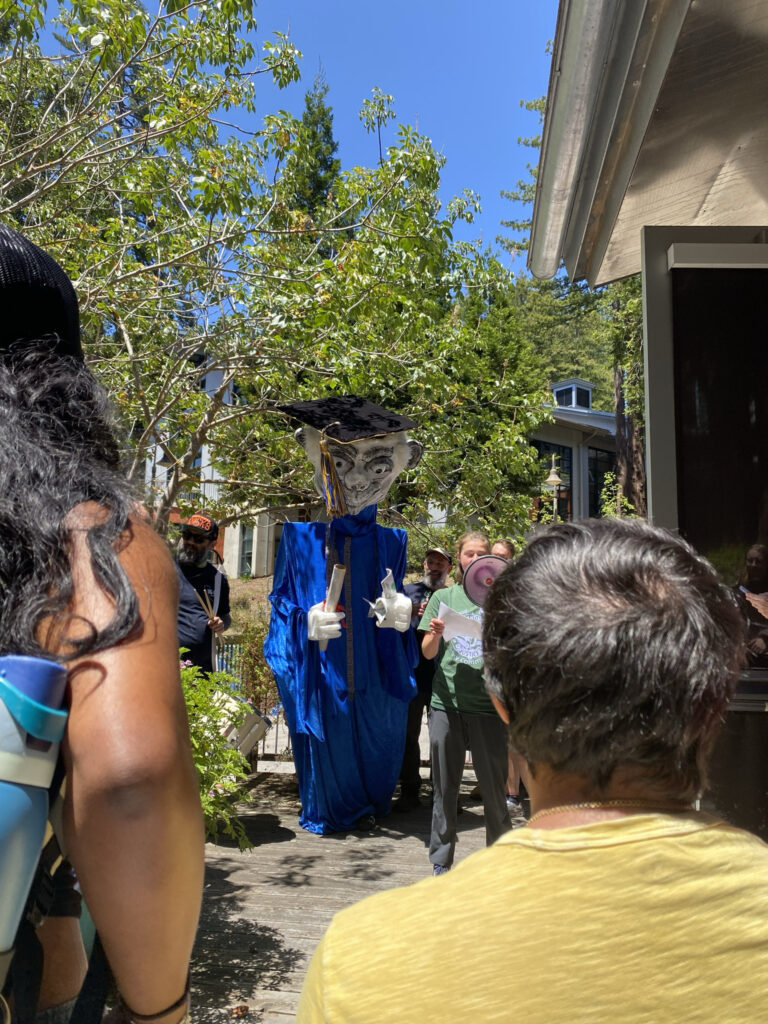
During the rally, the crowd was joined by Dean McSmarmy, who often makes appearances at UCSC, but the crowd scared him away by chanting “ain’t no power like the power of the people cause the power of the people don’t stop”
What UCOP Passed to UC-AFT
After the lunchtime break, the representatives of UCOP opened the discussion before presenting their proposals for the day. They started by expressing their concerns about our Article 35 proposal and argued that the purpose of collective bargaining was to ensure “labor peace.” Other representatives questioned whether Unit 18 Teaching Faculty could be considered “supervisors” under the definitions in HEERA. UC-AFT co-chief negotiator Kat Lewin quickly dismissed their concerns by reminding them that, “One way UC can ensure labor peace is by ensuring that [workers] don’t have to go on strike.” Their suggestion, that exercising our legally-protected rights would be “non-workable” from UC’s perspective, flies in the face of the principles of collective bargaining enshrined in existing labor law.
UCOP then proceeded to offer some “testimonials” of their own to support their proposals for the day on Article 18 (Resignation). A representative from UCSD told of her trials and tribulations when a Unit 18 Teaching Faculty stopped responding to university communications and engaging in their assigned duties. Unable to reach the lecturer, the university was forced to “make contingency plans for continuity of instruction.” Another UCOP representative told of trying to offer a Unit 18 lecturer a job and never hearing back about the offer. Such incidents have convinced the UCOP that they “need a mechanism” to address similar situations – what they are calling a “presumptive resignation” that would occur when the university does not hear back within 7 days. UCOP similarly presented their proposal on Article 16 – Medical Separation, which makes what they describe as “procedural changes,” while offering no specific examples of issues that have arisen from our current contract language.
Beyond their “testimonials,” UCOP did not produce any relevant data to support their claims about the urgent need for a “presumptive resignation” clause or revisions to our Medical Separation article. Our Table Team will review their proposed changes closely and carefully to ensure they cannot be abused to undermine our rights. But one thing remains clear: while teaching faculty continue to raise serious issues at our bargaining sessions, sharing heartbreaking stories about cancelled classes and mass layoffs, the university continues to respond with narrow, technical proposals that would only apply to a few people in rare cases. Thus far, they have been unwilling to offer any proposals that address the existential threats that we face.
Future Bargaining Sessions
At the very end of the day, we returned to the conversation about bargaining ground rules and the schedule for upcoming negotiations. UCOP representatives once again “testified” to the hardships they were forced to endure when we bargained on zoom because of the “chat and emojis” that had gone on. They repeatedly noted how “distracting” the emojis were, claiming their representatives had to “minimize the screen,” “close the chat,” or close their laptop entirely due to “sensory overload,” and charged that some in attendance were “doing a lot more than observing.” As one UCOP rep described, the bursts of emojis in support of our table team made him “feel like I was having confetti thrown in my face.” For these reasons, UCOP’s proposed ground rules that would turn off the chat feature entirely and limit zoom room access to 40 people, a significant decrease from their original proposal for a 475 person cap. Limiting the number of observers, they argued, would mirror in-person bargaining and avoid the “interruptions and disruptions” they experienced on zoom.
Our Table Team members repeatedly stressed that zoom bargaining is a vital way to expand our members’ participation in the bargaining process. “We are a democratic union,” said Joe Klett from UCB, “We have a responsibility to our members. They want to hear from you. They want to hear you directly.” They questioned why UCOP was insisting on having a list of observers attending on Zoom and what they planned to do with that list, especially given the UC has been found to have shared data with the federal government in recent weeks, to which the UCOP said they have no plans to “misuse” the data. But while the chat and emoji settings can be easily changed, the limits on observers on Zoom that UC is proposing would fundamentally restrict our members’ access. As Kat Lewin noted, Zoom makes bargaining accessible to people “whose lives will be changed by our contract [but] who are engaged with very important things that keep them from being here; childcare, elder care, members with disabilities… [this] is about the hundreds of people who could be in the room if not for the precarity of their lives.”
UC-AFT proposed additional dates for in-person bargaining sessions during the summer, including on June 30 (location TBD), but UCOP has only confirmed the details for one: a two-day session at UCSB on July 15 and 16. More information to come soon – for now mark your calendars and be there!
We passed our proposal on 7b to address the persistent challenges lecturers face around reappointment;
UCOP passed a suite of status quo proposals on job security (7a-d, 10, 22, 31) that do not address the critical issues we have raised;
UCI teaching faculty gave powerful testimony about the mass layoffs on their campus.
Your UC-AFT Unit 18 Table Team met for another negotiation session with UCOP on Thursday May 21. The session was held at UCI, where last summer, 48 lecturers in the School of Humanities received layoff notices – something like three quarters of lecturers in the division. Those layoffs have continued throughout the year and many teaching faculty are now anxiously awaiting reappointment letters they fear may never come. The session began with TT member Alison Lipman asking the UCOP for their responses regarding the mass layoffs at UC Merced, UC Berkeley, and UCLA raised in previous sessions. UC offered a written statement with vague sentiments such as “we listened” and “the campus is facing financial pressures and needs to make difficult decisions,” but ultimately claimed that these urgent and widespread layoffs are not part of the statewide collective bargaining process.
As with previous sessions, members of the UCI chapter offered brave and compelling testimonies about the layoffs on their campus and how they impact lecturers and their students. Aysel Atamdede, a lecturer in the UCI Composition Department, spoke about the particular vulnerabilities of pre-6 faculty amidst budgetary crises. Aysel had received a layoff notice last summer, just minutes before the June 1st deadline, only to receive a follow-up email eight days later rescinding it. She has lived in a state of limbo ever since, not knowing whether she’ll have a job in the year to come. Her comments were echoed by Robert Wood, who shared in his statement (read by Ben Garceau) how hopeful he was to receive a full-time appointment from UCI after years of teaching at multiple campuses, only to then be laid off again, so late in the academic year that he did not have time to find another job.
Laura Klein, who has taught French at UCI for 11 years, emphasized the particular plight of language instructors, who are facing layoffs across the state. Programs in Japanese, Korean, Academic English, Russian, Chinese, French, Italian, Persian, and Arabic have all been cut on campuses across the state, despite consistent enrollments. At UCI, the Chancellor has suggested these programs might be consolidated and replaced with online instruction. As Klein described: “Learning a language online is akin to swimming outside water: theoretically possible. In practice, impossible… Failing to properly fund language instruction compromises [UCI’s] fundamental educational mission.” Klein and her colleagues at UCI are now part of a statewide effort to understand the crisis facing language instructors.
If you are a language instructor facing similar cuts on your campus please let us know by completing this survey.
Additional statements were offered by Sharareh Frouzesh and Brook Haley, who both teach in the UCI Humanities Core, emphasizing teaching faculty’s urgent need for real job security.
What UCOP Passed to UC-AFT
After a lunch break, the representatives from UCOP rolled out a suite of proposals on job security, including articles 7a, 7b, 7c, and 7d, as well as Article 10, 22, and 31. Their presentation emphasized that their proposals simply aimed to “streamline” and “consolidate” current contract language to make it easier for administrators to implement our rights. There were some promising parts of UCOP’s proposals: for example, they proposed that the permanent augmentation policy used for Pre-Continuing Unit 18 Faculty be extended to Continuing Unit 18 Faculty, which would standardize how temporary augmentations become permanent. But even that proposal would do little to address the major concerns that Unit 18 Faculty face. UC-AFT members have made it abundantly clear at previous bargaining sessions that the current contract is failing lecturers and leaving us in crisis-level precarity. UCOP responded with a 90-minute, hyper-technical presentation whose main substance was that they had made few meaningful changes and mostly rearranged the same broken contract language. Given the morning’s powerful testimonials about the crisis lecturers are facing amidst budget cuts at UCI, their status quo proposals seemed painfully non-responsive.
Your UC-AFT Table Team will review the language in these proposals. But there were a few indications that UCOP’s revisions might make the very issues that teaching faculty have been raising worse. For example:
In our previous contract (2016-2020), notice for academic year appointments was required by June 1 (for both quarter and semester campuses) and notice for quarter/semester based appointments was required 30 days in advance.
In our current contract, we had two major wins on appointment notice timing: moving up the timeline for notice of academic year appointments (to May 1 for semester campuses and June 1 for quarter campuses), and for notice of quarter/semester based appointments to 60 days.
UCOP’s proposal would move the notice date back to July 1 for academic-year appointees on all campuses, and reduce notice to term-based appointees to 30 days.
What UCOP is proposing would not only undo our wins from the last round of bargaining, but reduce all academic-year appointees’ notice by one month on quarter campuses and two months on semester campuses from the long-time previous standard of June 1. Their proposals would similarly extend the timeline from the review processes for Continuing Appointments, and eliminate deadlines for notification of reductions in time and layoffs. In their presentation, UCOP’s representatives claimed they needed the additional time because they are understaffed and under-resourced, but their proposals threaten to put all lecturers in the state of limbo that Aysel described and create even more uncertainty around reappointments.
What We Passed to UCOP
At the end of the afternoon session, the UC-AFT Table Team passed our proposal on Article 7b – Letters of Appointment and Assignment, which complements our previous proposal on 7a. Our proposal aims to address the persistent issues lecturers face around reappointment, including late letters, last minute adjustments, and other issues that make it difficult for us to plan for the coming academic year.
The 7b proposal includes a new concept – Letters of Assignment – which would clearly indicate what you’re teaching, your full-time equivalent (FTE) percentage, and your base salary. It also adds new clarity around IWC (Instructional Workload Credit) evaluations for courses, which is how our FTE percentages are calculated, and around how and when teaching faculty with academic year appointments (who are paid for 9 months of service over 12 months) get paid. It will require consultation and advanced notice for substitutions and/or additions to our assigned duties, and additional transparency around departmental workload policies. We are also proposing to move up the deadline for reappointment letters to April 1 for semester campuses and May 1 for quarter campuses and to introduce a financial penalty for every day that letters are delayed to ensure those deadlines are met.
While UCOP offers proposals that protect the status quo, UC-AFT is fighting to expand our rights and address the immense challenges and uncertainty that UC teaching faculty face right now.
Next Session: June 4th at UCSC
At the end of the session, your bargaining team briefly addressed UCOP’s regressive proposal on ground rules proposal. Their proposal (passed to UC-AFT at our May 7 session) includes strict limits on Zoom bargaining, which would limit zoom access to 40 participants and enable UC to control and monitor all Zoom sessions. When asked when we might be able to bargain on Zoom again, they quickly wrapped the bargaining session without a definitive answer.
UCOP’s lack of response of Zoom bargaining makes it all the more important that we show up to support the table team in-person. Our next session will be in-person at UC Santa Cruz on June 4th – can you join us?RSVP here.
It was a BIG day: we proposed transformational language on Article 7a, which would protect our jobs, close loopholes, and create real job security
The session was chock-full of emotional testimony from UC-AFT faculty and students about the cruelty of precarity, with hundreds in the zoom room
Meanwhile, UC attempted to drag us back to the beginning of negotiations with a regressive proposal on ground rules.
The zoom room was packed with over 200 teaching faculty and students when our bargaining session with UC began on Thursday at 10am. The morning session consisted of moving testimony from our colleagues and students, including those from UC Berkeley’s FPF (Fall Program for First Semester), where 29 lecturers have recently received layoff notices. These lecturers had already been through a tough fight to win union recognition in the first place: having been denied access to healthcare and union salary scales for years, they filed Unfair Labor Practice charges that forced UCB to pay over $400,000 in unpaid back wages. UCB administration has now announced it will be shutting the 43 year-old program down, leaving hundreds of students without the support they need. “We explore the perspectives of others with more openness and intimacy than anywhere else on campus,” said FPF faculty Devin Leigh in his testimony. With his baby daughter in his lap, Leigh shared how his students have struggled with feelings of inadequacy, along with housing and food insecurity. “By closing FPF,” Leigh said, “UCB is closing one of the few spaces we have to intervene in people’s lives at meaningful moments.” His sentiments were echoed by fellow FPF lecturers Amy Lee, Sharon Coleman, Arunima Paul, and Ken Worthy, who added that after 12 years of teaching in the program, he still struggles to maintain consistent access to health insurance, library services, and even campus email. “It’s hard to be fully present for suffering students,” Worthy shared, “but I do it because they’re worth it.”
These sentiments were echoed by FPF students, who also packed the zoom room. Gabby, Brissias, Annaka, and Omar each shared that they would not have survived at UCB without the support they received from FPF teaching faculty. Most are first generation college students, living far from home, who relied on the academic and emotional support of their teachers to adjust to life on campus and find a sense of community and belonging. Others shared that the FPF program was what drew them to UCB in the first place, and alumni of the program noted that letters of recommendation from FPF lecturers helped them start their careers. “The way that Berkeley is treating their lecturers tells students, and the world, that Berkeley doesn’t care about education,” UCB student Gabby Wong asserted at the end of her testimony. “Students want smaller class sizes. Students want smaller sections. But most of all, students want lecturers’ livelihoods restored.”
The emotional testimony underscored what is at stake in our fight for real job security. They demonstrated that our work is not confined to the classroom, and that we provide our students far more than our academic expertise. Like FPF faculty, many of us teach core curriculum, smaller classes, and first-year writing classes that students rely on, providing crucial mentorship and support to our university’s most underserved and historically marginalized students. While we treasure the opportunity for substantive interaction and individualized learning, these courses are often the first victims of budget cuts. At the beginning of the session colleagues from UC Merced issued a forceful reminder to the UCOP’s representatives of the mass layoffs on their campus, where 25% of lecturers, including 40% of the writing program’s instructors, have been laid off since our last contract was signed in 2021. When pressed for a response at the last bargaining session, UCOP reps said they would “follow up” by the next session.
“What I want to say is, it’s personal, to all of us.”
After the students finished, several UC-AFT members spoke to the issues our proposals are designed to solve. Table Team member Alison Lipman, a Continuing Lecturer in Ecology at UCLA, shared her gut-wrenching experience of being recruited to develop field work courses in biodiversity in collaboration with Indigenous communities in Southern California, only to see those courses cut 15 years later. Even though Alison and her teaching partner won grant funding, spearheaded innovative ecological restoration projects on campus, and helped to build climate vulnerability assessment systems for the entire UC, they are being squeezed out of the department they’ve dedicated their lives to for no reason other than that they’re lecturers.
The combination of betrayal, sadness, and pride that Alison expressed echoed through the comments of other UC-AFT Teaching Faculty. Audrey Harris of the Dept. of Chicano and Central American Studies at UCLA, who brings local writers and prison educators into her classrooms, worries that she will be laid off as she approaches her excellence review for Continuing Status. Amanda Reiterman, who has taught in a half dozen different programs at UCSC because of the interdisciplinary nature of her research, doubts that she will ever achieve Continuing Status because those services credits don’t transfer across departments. Darlene Lee, who has trained hundreds of K-12 educators during her 18 years in the Education Department at UCLA, shared that social justice pedagogy and off-campus programs she has developed have repeatedly been cancelled for political reasons. Darlene captured what many of us feel: “My work has been treated as an interchangeable part in the machinery of the UC.”
What We Passed to UC: Article 7 and Job Protections
As evidenced by the moving testimony of UC-AFT members, the UC has gone out of its way to find and exploit loopholes in the job security protections we fought so hard to win in 2021. Sometimes in the name of austerity, sometimes as a thinly veiled attempt to discipline Unit 18 Faculty by generalizing precarity, UC has made clear it prefers to see us as expendable labor. In the afternoon session, our Table Team presented the first piece of their solution to the problem: a transformational new proposal on Article 7a, which covers academic appointments. Our proposal would restructure our positions as open-ended appointments with permanent budget lines. It would eliminate the painful reappointment process, meaning employment would continue from the date of hire unless the faculty member chooses to leave or is separated for a specific, contractually-defined reason (i.e. layoff, medical separation, etc.) and would have full due-process rights to challenge that separation. Other provisions of the new proposal would:
ensure that more Unit 18 faculty members’ work, such as teaching on multiple campuses or for several departments, will count towards continuing status;
create new protections against courses that Unit 18 Faculty design from being reassigned to senate faculty, graduate students, or other job titles;
require UC to offer augmentations to existing Unit 18 faculty rather than new hires, and to consider Unit 18 faculty for ALL the work they are qualified for,
empower our members to reach the appointment percentages they want and need;
close the many layoff loopholes UC has exploited to remove experienced teachers or avoid increasing their appointment percentages to reflect actual academic need;
protect against reductions in time.
As Table Team member Alison Lipman said, article 7a is the heart of our contract and winning strong academic appointment language would mean good, secure jobs for all teaching faculty. “I hope we can remember May 7th as a date that changes all of our lives and the university for the better. Our goals are to save jobs and save education. We’re proud of our work. I hope that UC can see the real benefits this can bring to the UC.”
After our Table Team’s stellar presentation, the UCOP representatives passed proposals of their own. The first involved Article 14 – Holidays, including changing the name of the March holiday to “Farmworkers’ Day” in accordance with new state guidelines. Unfortunately, UCOP’s second proposal flew in the face of everything that had been so powerful about the rest of the session. UCOP passed a regressive proposal on ground rules that would strictly limit access to our zoom bargaining sessions, give UCOP control over the venues in which we bargain (both online and in-person), and introduce new layers of surveillance. Asserting that access to our bargaining sessions should be limited to “individuals… impacted by the article being negotiated,” they suggested that our contract negotiations were not of “public” concern. We disagree: as teaching faculty of one of the largest public universities in the country, our contract negotiations should be as participatory, inclusive, and accessible as possible, not only for our members but for students and community members as well. The UCOP’s proposals are non-starters and our Table Team will counter.
Our next In-Person Bargaining session will be at UC Irvine on May 21 – Join us! RSVP here