

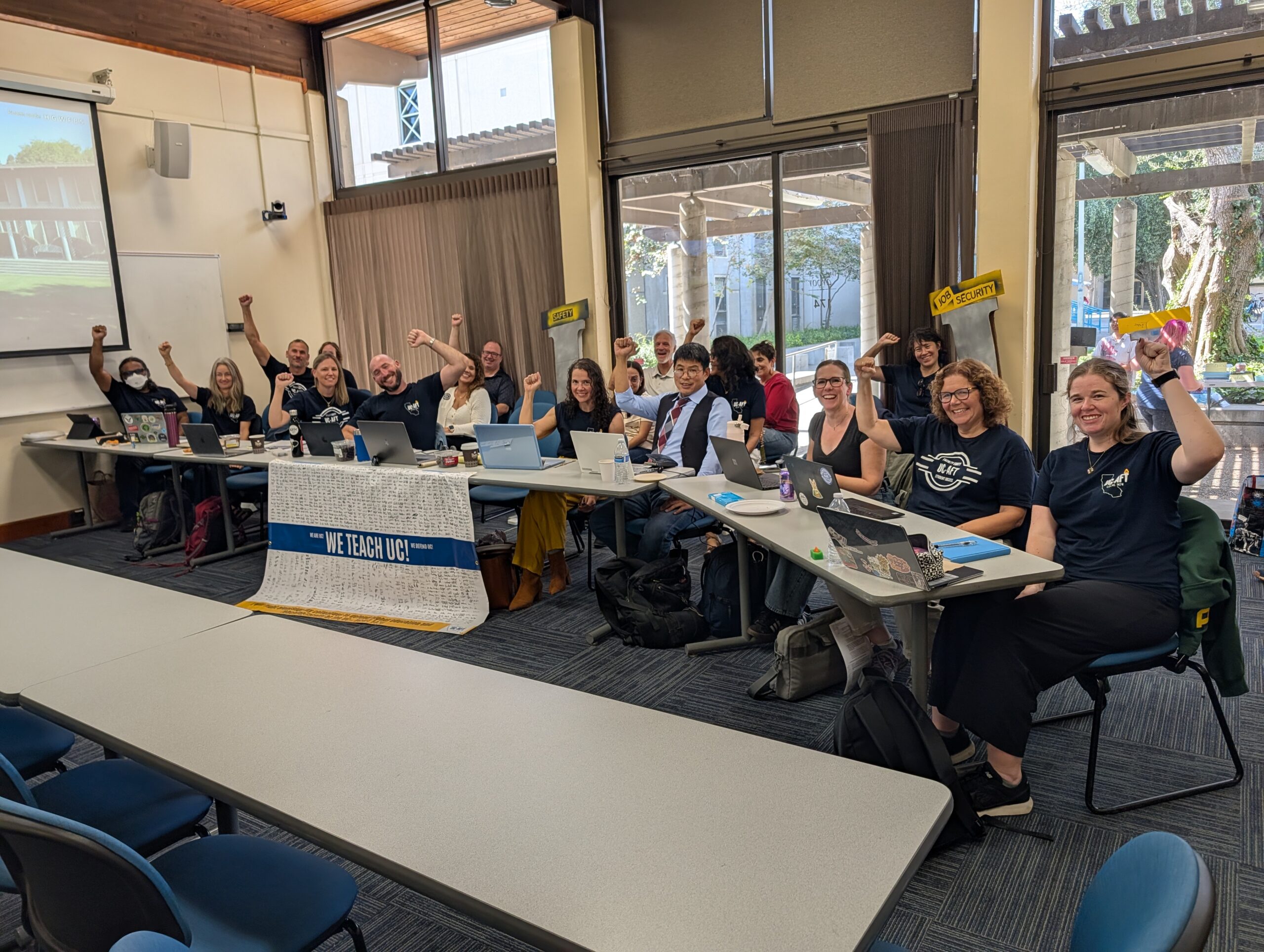
Your UC-AFT Table Team gathered in a packed conference room at UC Davis for another bargaining session on Thursday, Sept. 24. The biggest item on the agenda was workload (Article 24), with nearly a dozen UC-AFT members from UCD and UCB speaking about reductions in their appointments and the uncompensated labor they are regularly asked to perform, in addition to proposals on Instructional Support (Article 8), Layoffs (17), and Health and Safety (43). A clear theme emerged over the course of the day: classroom teaching at the UC has changed significantly since our last contract fight, and UC-AFT teaching faculty are fighting for proposals that will make our jobs more stable, better-resourced, and less administratively onerous so that we can deliver the high-quality education our students deserve.
Fair Workload Now!
The UC consistently devalues the work of its teaching faculty, which impacts many other aspects of our lives. While our current contract establishes that a full-time workload for lecturers cannot exceed 9 classes per 3 quarters (6 per 2 semesters), the way UC evaluates our workloads means that less than 20% of lecturers have full-time appointments and 56.6% of teaching faculty don’t have access to healthcare and benefits. Some teaching faculty make less money than their teaching assistants and much of the work we do – writing letters of recommendation, serving on departmental committees, developing new curriculum, etc. – is uncompensated. Undervaluing our labor also impacts our salaries: the average UC lecturer is making between $28,000 and $38,000 per year, forcing many lecturers to take on additional jobs to afford the rising cost of living in our campus communities. And because the most underfunded departments (where the majority of teaching faculty tend to be women and BIPOC folks) often have the highest workload thresholds, we do not have equal work for equal pay.
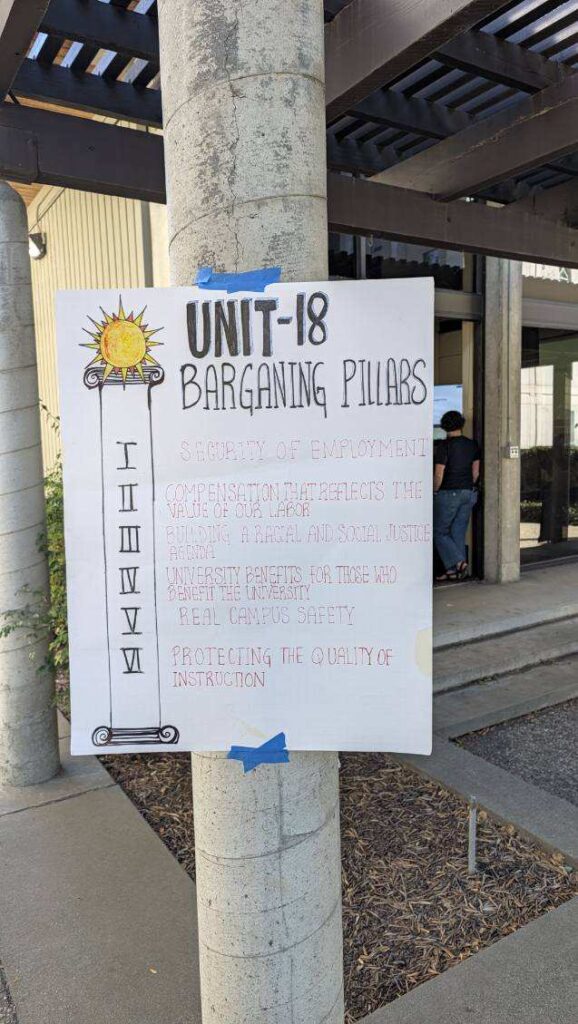
These themes echoed through the powerful testimonies of UC-AFT members in the morning session. Members from a variety of departments with very different classroom experiences offered compelling examples of how the work they do goes unrecognized and uncompensated. Rebecca Rosa, from the Teacher Education program at UCD, explained how the demands of her program – which includes field observation at multiple schools across the district, reviewing lesson plans, and giving one-to-one feedback – can mean teaching faculty spend nearly 30 hours per week outside of the classroom, even as they are compensated as part-time faculty. Michael Ball, who teaches in the EECS (Electrical Engineering and Computer Science) Department at UCB, testified about the EECS “Heaven Point” workload evaluation system, which has not been updated since the 1980s. By his calculations, under this workload formula, he has given about 1 year’s-worth of free labor to his students and his University, relative to other colleagues.
The major findings of recent research studies reflect what many of us have experienced:
- Student needs have changed with increasing numbers reporting disabilities, food and housing insecurity, and mental health challenges, including higher rates of ADHD, anxiety, and depression;
- Faculty perform “invisible” labor in navigating these student challenges in their teaching, including increased accommodation authorizations without any additional support;
- This “invisible labor” is not shared equally. Faculty of color and women experience higher workload in mentoring and advising students;
- There has been an increase in the use of educational technology (e.g. Canvas) and in student expectations of multimodal instruction and instructor responsiveness, which puts additional demands on teaching faculty;
- While the hype around generative AI promises to reduce workload, generative AI has dramatically increased workload for higher education faculty.
Lecturers in departments from Sociology to Journalism to Human Development and languages added testimony about how much their work has changed in recent years. Their testimonies made it plain to the UCOP negotiators: we need fair workload standards now.
Our Proposal on Article 24: Empowering Teaching Faculty
As reflected in the morning’s testimony, as well as countless discussions with members and multiple bargaining surveys, teaching faculty workloads vary across departments and campuses and are inconsistent, inequitable, outdated, and non-transparent. UC-AFT teaching faculty include dentists, musicians, supervisors of teacher education, studio artists, legal clinic supervisors, and nurses, making it nearly impossible to define one workload standard that takes into account all the ways we teach. Our current workload article sets the maximum workload for all lecturers at nine instructional workload credits (IWCs) per year (six at semester campuses), but gives the UC unilateral control in determining what constitutes one IWC, offering little recourse to lecturers whose classes are weighted wrongly.
Our proposal would fundamentally change how IWCs determined by:
- Redefining a full workload as 6 IWC per year, rather than 9 (or, for semester campuses, 4 IWC rather than 6), and setting a standard calculation of 1 IWC per course, to create more equitable workloads for all;
- Returning control over determining workload standards to departments and giving lecturers a seat at the table in those determinations;
- Clarifying what can be considered in determining IWCs and how courses can be considered more than (or occasionally less than) 1 IWC;
- Adding specificity for IWC calculations for supervisors, music, and other job titles;
- Adding an overload provision that allows teaching faculty to choose to accept additional classes even if it puts them over 100% appointment;
- Requiring additional transparency around departments’ workload policies, as well as regular workload reviews and recalculations;
- Creating new mechanisms for remediation when teaching faculty believe their IWC calculations do not reflect their actual workloads.
Our proposal would replace the current, all-too-complicated top-down formula, with localized decision-making, adding fairness across the system and creating more equitable workloads for all.
Read our proposal on Article 24 here
“We need 21st Century Classrooms”
After a break for lunch, UC-AFT presented its proposals on another article that impacts our workloads: Article 8 – Instructional Support. UCOP’s representatives seemed totally unaware of just how degraded our classrooms have become in recent years, as threats to campus safety have increased and support services have been cut. Through additional testimony, UC-AFT leaders made it clear that our facilities lack the reliable internet and cell phone service, display equipment and adapters, safety features, and ADA accessibility we need to do our jobs. Our proposal on Article 8 would codify these requirements and provide teaching faculty with stipends to purchase necessary materials of $400 per course for materials and $1500 annually for computers and other classroom technology.
UCOP’s representatives also seemed not to realize how UC’s steep cuts to graduate education have impacted our working conditions. Our graduate colleagues fought hard for the improved compensation they won in their last contract, but instead of increasing funding to cover these new costs, campus administrators have required departments to reduce the number of Academic Student Employees, with Unit 18 faculty often bearing the brunt of the cuts. Our proposal would establish equity with senate faculty in terms of the number of ASEs assigned to our courses and explicitly protect us from being forced to pick up struck work.
Read our proposal on Article 8 here
Later in the afternoon, our table team also presented a related proposal on Article 43 – Health and Safety. Once again, members spoke to the new threats to our classrooms that have emerged in recent years, including those related to the ever-growing impacts of climate change. As an increasing amount of our teaching occurs online, UC-AFT members have faced doxxing attacks from online mobs, often including physical threats to their safety, as well as unwanted surveillance in their classrooms. UC Davis was a fitting setting for the discussion: in recent years, Davis has been repeatedly blanketed in toxic smoke from wildfires, temperatures consistently reach over 100 degrees, and in 2023, the campus was besieged by a series of stabbing attacks that left two people dead.
In the face of these new 21st century threats, our table team is proposing to expand Article 43 in ways that will better enable us to maintain safe environments in our classrooms, both in person and online. This includes a new provision that will give Unit 18 teaching faculty the discretion to decide when an emergency on campus warrants a temporary modification to their courses.
“Working at UC can be a great job, unless you’re in constant fear of losing it”
Among the central priorities of our contract campaign is to establish true security of employment. This goal stretches across several articles in our contract, including the 7s (Articles 7a, b, c, and d), which outline the structure of our appointments, as well as Articles 22 and 31, which outline Merit and Academic Review Process. On Sept. 24, our table team put forward its proposal on another important aspect of our job security: our protections around layoffs, as outlined in Article 17.
UC-AFT members have pressed the urgent threat of layoffs at every one of our bargaining sessions with UCOP so far. Colleagues have shared heartbreaking stories of the impacts that layoffs have on our families and our students, particularly at UC Merced, where 25% of our bargaining unit was laid off as a result of the university’s “budget stabilization plan.” UC-AFT has since filed an Unfair Labor Practice (ULP) charge challenging this unlawful, unilateral change in our working conditions.
Our proposal on Article 17 aims to prevent these kinds of layoffs from happening again. It aligns the article with our proposal on 7a, which will do away with the reappointment process by establishing open-ended, fully-funded appointments for pre-6 lecturers. It limits the reasons for a layoff and prohibits the kind of mass layoffs that occurred at UCM. Pre-continuing Unit 18 faculty would no longer be able to be laid off for unspecified “lack of work” and our courses would no longer be reassigned to Senate faculty or graduate students. Layoff/RITs would only occur if there is a documented budget shortfall, and the notification times for layoffs would be extended. The proposal also will close existing layoff loopholes and strengthen lecturers’ rights to due process when their courses are cut and/or academic programs are closed. In combination with our other job security proposals, our proposal on Article 17 aims to bring an end to our precarity.
Read our proposal on Article 17 here
UCOP’s Proposals: More of the Status Quo
In the past two sessions, our Table Team has offered nearly a dozen substantive and transformational proposals on key articles to move us towards our mutually-agreed upon Dec. 1 deadline as quickly as possible. Our efforts have focused on the key priorities of our members and tackled the biggest challenges we face as UC teaching faculty. But UCOP has thus far refused to offer any substantive responses, including our proposals on job security (7a), technology in the classroom (44), or academic freedom (Article 2), which we offered at our first session back in March. Instead, they have offered modest changes to less structurally significant parts of our contract that largely protect the status quo. That tendency to avoid addressing our major concerns was reflected in the session at Davis, where they offered only one new proposal on Article 41 – Parking.
The rising costs of parking certainly impacts UC-AFT members, as do the skyrocketing costs of gas and other staple goods. But even as UCOP’s negotiators recognized that “the world is getting more expensive,” they are proposing to increase the previously-negotiated caps on parking fees that lecturers must pay. As table team member Kat Lewin noted, they are, in effect, “trying to recoup funds from a group of people who can’t afford to live near the University,” imposing new financial penalties on already underpaid lecturers who are denied access to the housing support they offer tenure-track faculty and forced to negotiate an increasingly hostile rental market.
Join the Fight for Faculty Equity: Oct. 8 at UC Riverside
What has become abundantly clear in these last two bargaining sessions is that if we want UCOP to take our demands seriously, we must demonstrate our will to win them. Now’s the time to get involved – join our fight for the UC we deserve!
Our next bargaining session will be at UC Riverside on Oct. 8, starting at 10am. Join your colleagues at INTS 113 – RSVP!
Leave a Reply